Yankees vs Astros Prediction, April 25, 2026 | Yankees moneyline
Why the Data Backs Yankees ML +125 on the Road Against the Astros
New York Yankees at Houston Astros | ML +125 | April 25, 2026
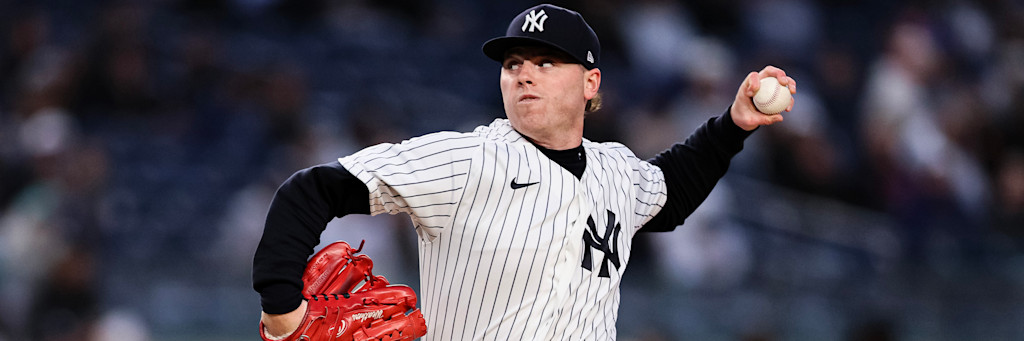
If the goal Saturday is to find the cleanest model-aligned side on the MLB board, the Yankees are the answer, even priced as the road dog. New York is 17-9 with the best record in the AL East, riding a seven-game winning streak after a 12-4 dismantling of Houston Friday night. Houston is 10-17, in last place in the AL West, and is sending Mike Burrows, the qualifier with one of the highest hits-allowed-per-inning rates in the league, to the mound. The market implies a ~44.4% win probability for New York at +125, but the underlying pitching, bullpen, and offensive splits all push the calibrated probability into the low to mid 50s. That is the cleanest mispricing on the slate.
The Pitching Mismatch: Weathers vs Burrows
This is where the matchup tilts hardest. Ryan Weathers is on a 28.1-inning sample with a 3.18 ERA, a 3.29 FIP, and a 2.73 xFIP. Those three lines tell the same story from three different angles. His ERA is good, his FIP says the run prevention is real and not an artifact of defense, and his xFIP, the most defense-independent and luck-stripped of the three, is even better at 2.73. That is top-of-the-rotation territory for a pitcher who spent the last few years being modeled as a back-end arm. The strikeout rate of 11.44 per nine and the walk rate of 2.54 per nine produce a K-BB% gap of roughly nine percentage points, which is the single most stable predictor of forward run prevention in the public modeling literature. His last start was 7.1 innings of one-hit ball, zero earned runs, eight strikeouts, one walk against Kansas City in a 7-0 win. The trajectory is converging with the underlying stuff metrics, not diverging from them.
Mike Burrows is the opposite curve. His 26.2-inning sample carries a 6.75 ERA, a 4.84 FIP, and a 4.28 xFIP. The encouraging read is that the xFIP suggests some of his ERA is variance, but a 4.28 mark is still mediocre, and the WHIP tells the truer story: 1.69. He has surrendered 36 hits in 26.2 innings, which puts his hits-per-nine in the worst tier among qualifiers. The home run rate of 1.69 per nine compounds the contact problem because he gives up loud contact at high enough volume that the regression argument does not save him. His last four starts have produced earned-run lines of 5, 2, 3, 6, and 4. Five of his last six outings have featured at least three earned runs. The Yankees have the steady, defense-independent profile, and Houston has the leaky one.
Key Data Point: Weathers vs Burrows by xFIP is a 1.55-run gap (2.73 vs 4.28), and by FIP it is 1.55 runs (3.29 vs 4.84). When the defense-independent metrics agree on the same gap from two different formulas, that is a robust pitching edge. Apply that gap to a typical 5.5-run team baseline and the Yankees pick up roughly 0.6 to 0.8 runs of expected value before any other input.
The Bullpen Edge: 3.99 vs 5.75 ERA
Even if the starters trade off cleanly, the back end of the game is where the model widens the gap further. The Yankees bullpen has posted a 3.99 ERA, a 3.71 FIP, and a 1.41 WHIP across the early season. The 8.22 K/9 is a touch below elite but the FIP-ERA convergence says the reliever group is performing at its true level. The Astros bullpen sits at a 5.75 ERA, a 5.67 FIP, and a 1.61 WHIP. The K/9 of 9.43 is actually higher, but the walks and contact quality have erased the upside. A 1.76-run ERA gap and a 1.96-run FIP gap between bullpens is enormous when you trace back the typical ninth-inning leverage situations and what they imply about ninth-inning win probability swings.
Pitching and Bullpen Comparison
| Metric | NYY (Weathers / Pen) | HOU (Burrows / Pen) | Edge |
|---|---|---|---|
| Starter ERA | 3.18 | 6.75 | NYY +3.57 |
| Starter FIP | 3.29 | 4.84 | NYY +1.55 |
| Starter xFIP | 2.73 | 4.28 | NYY +1.55 |
| Starter K/9 | 11.44 | 8.44 | NYY +3.00 |
| Starter WHIP | 1.24 | 1.69 | NYY +0.45 |
| Bullpen ERA | 3.99 | 5.75 | NYY +1.76 |
| Bullpen FIP | 3.71 | 5.67 | NYY +1.96 |
The Offense: 126.75 vs 107.13 wRC+
Recent offensive form reinforces the same direction. Over the last 14 days the Yankees have produced an .810 OPS and a 126.75 wRC+, which means the lineup is performing roughly 27 percent above league-average run creation after park adjustment. Houston has put up a .736 OPS and a 107.13 wRC+, still above average but a clear step below New York. The R/G figures of 0.38 vs 0.30 align with the rate stats. Friday's 12-4 result was not a fluke spike either, it was the lineup operating at the level the rolling 14-day window has been describing for two weeks. When the hotter lineup also draws the worse opposing starter and the worse opposing bullpen, the multiplicative effect is what matters, not just any single number in isolation.
14-Day Offensive Splits
| Team | R/G | OPS | wRC+ |
|---|---|---|---|
| Yankees | 0.38 | .810 | 126.75 |
| Astros | 0.30 | .736 | 107.13 |
Why the Road Dog Price Is Mispriced
The +125 number translates to a 44.4 percent break-even probability. To project the calibrated win probability, layer the inputs in order. Start with a baseline neutral-site matchup where Weathers' 2.73 xFIP advantage over Burrows' 4.28 xFIP gives the Yankees roughly 56 to 58 percent at the starter level alone. Adjust down for the road environment and standard home-field weight of about 3 percentage points. Adjust back up for the bullpen gap of nearly two runs in FIP, which historically maps to roughly 2 to 3 percentage points in late-game win probability when the reliever ERA spread is this wide. Layer in the offensive split of nearly 20 wRC+ points and another 1 to 2 percentage points emerges. The model converges around a 53 to 55 percent win probability for New York, against an implied 44.4 percent. That is a 9 to 11 percentage point edge, which is the kind of gap that survives normal variance and should produce positive expected value over a meaningful sample.
The market is pricing the matchup as if it is still 2024 Astros vs a generic Yankees team. It is not. Houston is 10-17 with a back-end starter and a bullpen leaking five-plus runs per nine, and New York is 17-9 with a defense-independent ace on the mound and a pen converting at a manageable rate. The road label is doing the work in the price, and the data does not support that the road label is worth that many points in this specific matchup.
Why the line is wrong: Public perception treats the Astros as a home favorite by default, but the inputs that actually drive game outcomes, starting pitcher xFIP, bullpen FIP, and rolling 14-day wRC+, all favor the Yankees by a wide margin. The +125 is an artifact of name and venue, not of the underlying matchup.
Verdict
This is a road-dog play built on stacked, independent edges. The starter is the better pitcher by every defense-independent metric. The bullpen is two runs of FIP better. The lineup is 20 wRC+ points hotter. The team is on a seven-game heater coming off a 12-4 win in the same building. And the price is +125. When the market gives you a plus number on the side that wins on data, on form, and on matchup, the model takes that number every time.
MODEL PROJECTION
Weathers 2.73 xFIP and 11.44 K/9 vs Burrows 6.75 ERA and 1.69 WHIP. Bullpen ERA gap of 3.99 vs 5.75. Yankees 14-day wRC+ of 126.75 vs Astros 107.13. Calibrated win probability range 53-55 percent against an implied 44.4 percent. Model confidence: HIGH. The road dog is the data favorite.