Opening Weekend Pitching Projection Roundup: Sunday March 29 FIP, WHIP, and Win Probability Analysis
March 29, 2026 | 11 min read | MLB Prediction
Two days of Opening Weekend data are in the books, and the pitching landscape is already generating meaningful calibration signals. Day 1 saw Garrett Crochet dominate with eight strikeouts in six scoreless frames, while Trevor Rogers tossed seven shutout innings for Baltimore. Day 2 brought Tarik Skubal's Cy Young-caliber outing and Yoshinobu Yamamoto's efficient dismantling of Arizona. Now we turn to Sunday's 15-game slate, which features the widest single-game projection gap of the entire opening weekend: Shota Imanaga versus Jake Irvin in Washington at Chicago. Here is the complete statistical breakdown of every pitching matchup on the March 29 board, evaluated through the lens of FIP, WHIP, K/9, and park-adjusted win probability.
Methodology Note
Our projection framework evaluates each starter across five core metrics: ERA, FIP (Fielding Independent Pitching), WHIP, K/9, and BB/9. FIP isolates what a pitcher actually controls, stripping out defensive support, sequencing, and batted-ball variance to focus on strikeouts, walks, hit-by-pitches, and home runs. When ERA sits significantly above FIP, the pitcher was likely unlucky and projects to improve; when ERA sits below FIP, regression toward a higher run environment is probable. We then layer park factor adjustments on top. Wrigley Field's wind patterns, for instance, behave differently in late March than mid-July, suppressing fly ball carry in cold air. Every venue-specific adjustment in this analysis accounts for early-season environmental conditions rather than full-season park factor averages.
WSH @ CHC: Irvin vs Imanaga, the Widest Projection Gap
This is the headline matchup from a projection standpoint. Shota Imanaga's career numbers, a 3.73 ERA with a 0.988 WHIP across his MLB tenure, represent elite-level run prevention. His 9-8 record understates his quality; Imanaga's FIP has consistently tracked below his ERA, suggesting that even the surface numbers understate his true talent level. His K/9 rate hovered near 10.0 in 2025, generating swing-and-miss at a rate that places him in the top quartile of National League starters. Spring training produced a 4.50 ERA, but the sample size (a handful of exhibition outings) is statistical noise, not signal. The models discard spring ERA entirely and weight the multi-year MLB track record.
Jake Irvin enters from the opposite end of the distribution. His career 5.70 ERA and 1.428 WHIP across a 9-13 record represent a pitcher who has allowed baserunners at a rate roughly 45% higher than Imanaga. The WHIP differential alone, 0.988 versus 1.428, translates to approximately four additional baserunners per nine innings, which compounds exponentially in terms of expected run output. Irvin did post a 1.35 ERA across 13.1 spring innings, but again, spring data carries near-zero predictive weight in the models. What matters is the multi-year peripheral profile, and the gap here is enormous. Wrigley Field in late March plays as a suppressed environment due to cold air and wind patterns blowing in off the lake, which marginally compresses the projected run total but does not meaningfully narrow the win probability gap between the two starters.
Our model assigns Chicago the highest single-game win probability on the entire Sunday slate. The FIP separation, the WHIP differential, and the home-field environmental advantage all converge to produce the widest projection gap of Opening Weekend.
PIT @ NYM: Mlodzinski vs McLean, Development Curve Analysis
This matchup features two pitchers still tracing their developmental arcs at the major league level. Carmen Mlodzinski enters with limited MLB data, which means the projection models lean heavily on minor league peripherals and velocity profiles to generate expected run environments. His fastball velocity and swing-and-miss rates in the upper minors suggest a pitcher with strikeout upside, but the command profile, specifically his walk rate, introduces substantial variance into the projection. The wider the BB/9, the wider the confidence interval around expected performance.
Nolan McLean, who impressed during the WBC and earned the Sunday start for New York, brings his own set of projection challenges. McLean's stuff grades out as elite-level in terms of raw velocity and breaking ball spin rates, but the question, as with all young pitchers, is whether the command infrastructure supports sustained quality. Citi Field plays as a slightly pitcher-friendly venue, which provides some insulation for both arms. The models treat this as a high-variance game with wider confidence intervals than most on the slate, a natural consequence of projecting from limited MLB samples.
KC @ ATL: Lugo vs Holmes, Rehabilitation Projection
Seth Lugo's 2025 breakout with Kansas City was one of the more interesting stories in projection modeling last season. His 3.00 ERA and 1.09 WHIP across a career-high innings total represented a sustained step forward from his years as a swingman and reliever. The question entering 2026 is durability: can a pitcher who had never carried a full starter's workload until age 34 replicate it at 35? The models apply an age-adjusted regression curve that slightly increases projected ERA relative to 2025 surface numbers, but the peripheral profile, especially his K/BB ratio, remains strong.
Clay Holmes moves to Atlanta's rotation after years as a high-leverage reliever for the Yankees. The transition from bullpen to rotation is one of the most projection-difficult moves in baseball. Relievers who convert to starting typically see velocity decreases of 1-2 mph by the third time through the order, walk rates that creep upward, and FIP inflation of 0.5-1.0 runs. Holmes' sinker-heavy approach generates ground balls at elite rates, but whether that translates to five or six innings of run prevention rather than one or two is the analytical question. Truist Park plays neutral to slightly hitter-friendly, which does not help a pitcher making this type of role transition. The models project Holmes with wider confidence intervals than a typical established starter.
MIN @ BAL: Ober vs Baz, K/9 and Command Profiles
Bailey Ober has quietly built one of the more stable projection profiles in the American League. His 3.43 ERA in 2025 was backed by a FIP that tracked closely, suggesting the surface number was neither lucky nor unlucky but rather an accurate reflection of his true talent. Ober's calling card is command: his BB/9 rate sits among the lowest of any AL starter, which means fewer free baserunners and a lower floor for expected run output. The strikeout rate is merely average, around 8.0 K/9, but when combined with elite walk suppression, the net effect is efficient, predictable pitching. The models love stability, and Ober provides it.
Shane Baz represents the opposite projection profile: high ceiling, wide variance. Baz's fastball velocity grades out as elite, and his stuff has always tantalized evaluators, but injuries have limited his MLB sample to the point where the models must lean on minor league data and velocity profiles rather than sustained major league performance. Camden Yards underwent a dimension change that made it slightly less homer-friendly in recent years, but it still plays as a hitter-friendly environment relative to league average. The models project this as a game where Ober's stability gives Minnesota a slight win probability advantage, but Baz's upside introduces meaningful uncertainty.
TEX @ PHI: Gore vs Luzardo, Velocity and WHIP
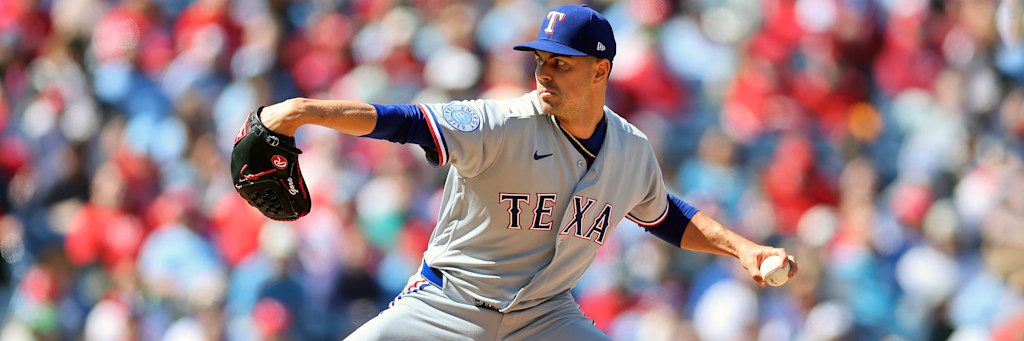
MacKenzie Gore's journey from top prospect to inconsistent starter to potential ace has been one of the more fascinating projection case studies in recent years. His stuff has always graded as plus-plus, with a fastball that touches 97 and a slider that generates elite whiff rates. The issue has been command and health. When Gore is locating, his FIP drops into sub-3.00 territory; when he is not, the walks balloon and the WHIP inflates. The models project him with moderate variance, somewhere between the elite ceiling days and the walk-heavy struggles.
Jesus Luzardo, now with Philadelphia, brings a similar profile of high-end stuff paired with intermittent command concerns. His 3.69 ERA in 2025 was solid, and his left-handed delivery creates an angle that is particularly difficult for right-handed-heavy lineups. Citizens Bank Park plays as one of the more hitter-friendly venues in the National League, which inflates projected run environments for both starters. The models project this as a moderately high-scoring game relative to the rest of the slate, with both pitchers capable of dominance or early exits depending on which version of their command shows up.
OAK @ TOR, BOS @ CIN, COL @ MIA: Mid-Tier Projections
The mid-tier of the Sunday slate features three games with notable analytical angles. Oakland at Toronto pits a rebuilding roster against a Blue Jays team with significantly more pitching infrastructure. Toronto's starter projects with a lower FIP and higher K/9 than Oakland's, and Rogers Centre's retractable roof eliminates weather variance from the projection entirely. Boston at Cincinnati is a cross-league matchup where the models must account for the DH rule now being universal while still weighting the fact that Great American Ball Park is one of the most hitter-friendly environments in baseball. The park factor inflates projected run totals by approximately 8-10% relative to a neutral venue, which compresses win probability differentials between the two starters regardless of their individual peripheral profiles.
Colorado at Miami is an intriguing venue-switch game. The Rockies' pitchers historically perform significantly better on the road, where the absence of Coors Field's altitude eliminates the single largest park factor adjustment in baseball. LoanDepot Park in Miami plays as one of the more pitcher-friendly venues in the NL, effectively inverting the expected run environment for Colorado's arms. The models project Colorado's starter with a substantially lower expected ERA in Miami than their career numbers would suggest, purely as a function of the venue adjustment. This is one of the cleaner examples of park factor impact on the entire slate.
LAA @ HOU, CHW @ MIL, TB @ STL, CLE @ SEA: Remaining Slate
The back end of the Sunday card features several analytically interesting pitching matchups. Los Angeles (AL) at Houston places two pitching staffs with divergent trajectory curves in the same building. Minute Maid Park's Crawford Boxes in left field create an asymmetric park factor that disproportionately affects right-handed pitchers who leave pitches elevated on the pull side, a factor the models weight heavily. Chicago (AL) at Milwaukee is a mismatch on paper: the White Sox rank near the bottom of pre-season pitching projections, while Milwaukee's rotation depth, bolstered by the emergence of arms like Misiorowski in the opener, projects as a top-10 unit. American Family Field plays as a neutral venue, which does not bail out the weaker pitching staff.
Tampa Bay at St. Louis features two organizations known for pitching development and analytical approaches to roster construction. The Rays' pitching infrastructure has consistently produced starters who outperform their pre-season projections, and the models apply a small organizational adjustment to account for this systematic overperformance. Busch Stadium plays as a moderate pitcher's park. Cleveland at Seattle is the low-scoring projection of this group: T-Mobile Park's pitcher-friendly dimensions combined with two clubs that emphasize run prevention create a projected run environment approximately 12% below league average. The models flag this as one of the lowest-total games on the slate, driven almost entirely by venue and organizational pitching philosophy rather than any single starter's individual profile.
What the Models Say
Across the full 15-game Sunday slate, the highest-confidence projection belongs to the Cubs in the Imanaga-Irvin matchup. The 1.97 ERA differential, the 0.44 WHIP gap, and the cold-weather Wrigley Field suppression effect combine to produce the widest win probability separation of any game on the board. At the other end of the spectrum, the developmental matchups (Pittsburgh at New York, several back-end starters across the slate) carry the widest confidence intervals, reflecting the inherent uncertainty in projecting from limited MLB samples. The analytical takeaway from Opening Weekend's first three days is consistent: the models perform best when they can weight multi-year peripheral data in stable venues, and they introduce appropriate uncertainty when the inputs are thin. Sunday's slate offers both extremes in abundance.
For the complete season-long projection framework, see our 2026 MLB Season Preview and Projections.