Every model that projects baseball run scoring eventually collapses to a single question: how often does the ball get put in play, and what happens when it does. Strikeout rate removes outcomes from the distribution entirely, and contact suppression shrinks the damage on the balls that remain. The June 17 board is unusually rich in starters who do both, which is why the projection model leans toward run prevention across the slate. The headline outputs are the Rays team total under 3.5 at -148 for 3 units, the Yankees moneyline for 3 units, and the Tigers versus Astros under 8.5 for 1 unit.
The Framework: Why Strikeouts Anchor A Run Projection
Begin with a simple identity. A team's expected runs in a game is a function of how many baserunners it generates and how often those runners are driven in, and both terms shrink when the opposing starter misses bats. A strikeout is the only batted-ball outcome with a zero run-expectancy contribution, which makes the starter's strikeout rate the single most predictive input for a team total. The second input is contact quality allowed, because a starter who limits hard contact compresses the right tail of the run distribution even on the balls that are put in play. When both inputs point the same direction, the projection narrows and the edge against an inflated total grows.
Rays Team Total Under 3.5: The Ohtani Variable
| Team | Probable starter | 2026 record |
|---|---|---|
| Rays | Shane McClanahan (LHP) | 41-29 |
| Dodgers | Shohei Ohtani (RHP) | 47-27 |
By far the heaviest projected edge on the board is the Rays team total under 3.5 against Shohei Ohtani at Dodger Stadium. The model treats the opposing starter as the dominant variable in a team total, and Ohtani is the kind of arm whose stuff sits at the top of any strikeout-rate distribution. A Tampa Bay offense that ranks in the middle of the league for run production, playing on the road against premium velocity and a put-away breaking ball, projects below the 3.5 line before any park adjustment.
The -148 price is not a deterrent inside the framework; it is a confirmation. When the market and the model agree that an arm suppresses a road offense, the price climbs and the edge migrates from the line to the conviction. The model sizes the Rays under at 3 units precisely because the projection clears the implied break-even with margin, and because the team total is a contained bet that isolates the Tampa Bay run column from the noise of the Dodgers offense entirely. Isolating one variable is what makes a heavier stake defensible.
Yankees Win Probability: A Team-Quality And Home Edge
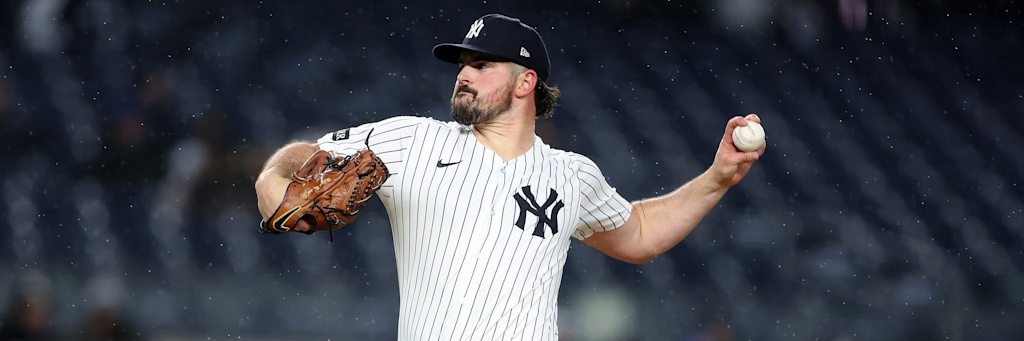
Cleanest of the win-probability outputs is the Yankees moneyline. New York enters at 44-27, the strongest record in the American League East, hosting a Chicago White Sox club whose roster quality and rotation depth sit well below the Bronx standard. Carlos Rodon takes the ball against Anthony Kay, and while the model does not weight a starter's win-loss record, it does weight the surrounding team-quality gap, the home-field run environment, and the bullpen depth behind the starter. All three favor New York.
The win-probability projection lands comfortably above the price's implied threshold, which is why the Yankees earn a 3-unit stake alongside the Rays under. A first-place club at home against a road opponent it should beat more often than not is the steadiest win-probability spot a model can output, and steadiness is what justifies the size. The variance on a single-game moneyline against a weaker club is low, and low variance is where the model concentrates capital.
Tigers Astros Under 8.5: Two Starters Compress The Total
| Team | Probable starter | 2026 record |
|---|---|---|
| Tigers | Casey Mize (RHP) | 30-43 |
| Astros | Peter Lambert (RHP) | 34-41 |
Down the board, the Tigers versus Astros under 8.5 is a game-total output where the model reads both starters as run suppressors relative to the number. Casey Mize for Detroit and Peter Lambert for Houston headline a matchup where the projected combined run total lands beneath 8.5 once the strikeout-rate and contact-suppression inputs are applied to both lineups. The model trims this to 1 unit because a game total carries more variance than a team total; the run distribution for a full nine innings has a fatter tail than the distribution for a single team's run column, and the stake reflects that wider spread.
The honest read here is that two clubs sitting below .500 do not always produce a pitching gem, but the number itself does the work. An 8.5 in a matchup of two starters the model grades as average-or-better run suppressors is a line the projection clears on the under more often than not, and the light stake is the correct hedge against the variance.
The Full Projection Board
Beyond the three headline outputs, the model touches several more games on June 17, each sized by the width of its projected edge.
| Projection | Line | Units | Primary input |
|---|---|---|---|
| Rays/Dodgers game total under | +100 | 2.0 | Ohtani strikeout rate, McClanahan run suppression |
| Rays team total under | 3.5 (-148) | 3.0 | Road offense vs top-tier strikeout arm |
| Yankees moneyline | -171 | 3.0 | Team-quality gap and home run environment |
| Pirates/Athletics game total over | 10 (-115) | 2.5 | Park run-environment factor at Sacramento |
| Brewers/Guardians game total under | 7.5 (-105) | 1.0 | Gavin Williams strikeout rate |
| Red Sox team total under | 4.5 (-105) | 1.5 | Below-line Boston run rate |
| Tigers/Astros game total under | 8.5 (-110) | 1.0 | Two average-or-better run suppressors |
| Cubs run line | -1 (-145) | 2.0 | Win-margin projection vs a last-place road club |
The single over on the board, Pirates versus Athletics over 10, is not a contradiction of the run-prevention theme. It is the same framework applied to a park rather than a pitcher. The Athletics' Sacramento home environment grades as a run-friendly factor in the model, and a total set at 10 in that environment is one the projection reads upward rather than downward. The model does not have a directional bias toward unders; it follows the inputs, and at Sacramento the inputs point up.
How The Model Sizes Each Output
Stake size in the framework is a direct function of two things: the gap between the projection and the market line, and the variance of the bet type. A team total is the lowest-variance output because it isolates one club's run column, so the Rays under at 3 units carries the heaviest stake. A single-game moneyline against a weaker opponent is similarly low-variance, which is why the Yankees match it. Game totals sit higher on the variance curve, so the Tigers/Astros under and the Brewers/Guardians under carry 1-unit stakes even when the model likes the side. The run-line output, Cubs -1, is a win-margin projection that the model grades as a 2-unit edge against a 28-46 Colorado road club.
The Honest Counterpoint
A projection model is a distribution, not a guarantee, and the model names its own failure modes. The Rays under leans on Ohtani holding his strikeout profile; a short outing that hands the ball to the bullpen early can widen the Tampa Bay run distribution past 3.5. The Yankees win-probability edge has no plus-money cushion at a minus price, so a single poor Rodon start can flip it. Game totals like the Tigers/Astros under are the highest-variance outputs on the board, which is exactly why they carry the lightest stakes. Lineups were not all confirmed at publication, so the projections assume the listed regulars. A model that respects variance sizes for it, which is the entire point of the unit structure.
What Beats It
An early multi-run inning beats the run-prevention board. The projection assumes the starters hold form and the strikeout rates suppress the offenses as graded; the night a top arm leaves early, the team total and the game total both come under pressure at once. The Yankees win-probability edge falls to a quiet Bronx lineup or a Rodon clunker. The model is favored on its outputs, but favored is a probability, not a result.
Final Verdict
The June 17 projection model outputs the Rays team total under 3.5 at -148 for 3 units, the Yankees moneyline for 3 units, and the Tigers versus Astros under 8.5 for 1 unit as its headline edges, with the full board sized by projected gap and variance. The throughline is run prevention read through starter strikeout rate and contact suppression, with the Sacramento park factor the lone upward signal. For more model work, see the advanced stats hub, the latest projections, and the prediction archive.
Picks and odds come from the BetLegend daily tracker. Probable starters, records, matchups, and venues were verified against MLB Stats API data for June 17, 2026.
Related Projection Models
More daily run-prevention and run-suppression reads built on the same strikeout-rate, WHIP and park-factor framework:
- June 18 run-prevention model: Guardians Brewers under and a Red Sox team total under
- June 16 total projection: Red Sox vs Blue Jays under 7.5 on Cease's strikeout rate
- June 19 run-prevention read: Padres team total under 3.5 versus deGrom
- June 14 run-expectancy model: Mariners moneyline and pitching-heavy unders
For the inputs behind every projection, read how the MLB prediction model works, and review the model's public track record and graded results.