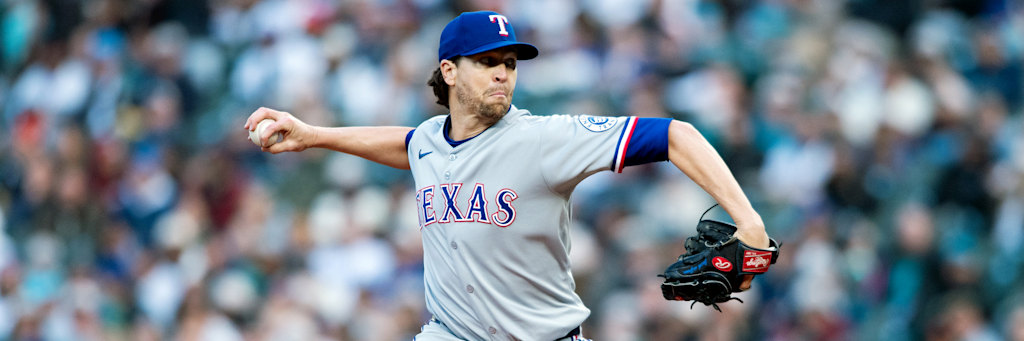
The cleanest output a team-total projection produces is the one where both input variables point the same direction. Most games force a model to weigh a strong offense against a weak pitcher, or a weak offense against a strong one, and the projection lands near the market line because the terms partially cancel. The June 19 board hands us the rare case where they reinforce each other. The San Diego Padres team total under 3.5 at -150 for 2.5 units pairs the worst offense in the National League with one of the most accomplished strikeout arms in the sport. When the hitting term is low and the suppression term is high, the projected run distribution collapses, and the under becomes the edge the model wants.
The Framework: A Team Total Is Two Distributions Multiplied
A team-total projection is not a single number, it is a probability distribution over runs, built from two inputs. The first is the hitting club's baseline scoring rate, expressed through its average, on-base, and slugging profile. The second is the opposing starter's run-suppression profile, expressed through strikeout rate, walk rate, and contact quality allowed. For a typical game these two terms are roughly balanced, and the model's projected mean lands within a quarter run of the market. The edge cases, the ones worth staking, are the games where one or both terms sit at a distributional extreme. June 19 gives us both at once: an offense in the bottom tier of the league against a starter who misses bats at an elite rate. That is the textbook setup for a team total to project well under the posted line.
Variable One: San Diego's Offense Is The Worst In The League
| Offense metric | San Diego (2026) | NL context |
|---|---|---|
| Team batting average | .218 | Bottom of the National League |
| Team OPS | .652 | Lowest in the NL |
| Runs scored | 280 | Among the fewest in baseball |
| Slugging | .361 | Bottom-tier power output |
That first variable is not a small input. San Diego is hitting .218 as a team with a .652 OPS, the lowest in the National League, and has scored just 280 runs on the season behind a .361 slugging mark. This is not a slumping good offense, it is a structurally weak one that has not produced consistent run-scoring at any point. A team that struggles to slug and struggles to get on base produces a run distribution that is already skewed low before you account for the pitcher, and three and a half is a number this lineup fails to reach on a meaningful share of nights even against league-average arms. The baseline alone pushes the projection toward the under. The second variable pushes it much further.
Variable Two: The deGrom Suppression Term
| Texas starter | 2026 line |
|---|---|
| Jacob deGrom (RHP) | 3.17 ERA, 0.99 WHIP, 89 K / 76.2 IP, 5-4, .211 BAA, 10.45 K/9 |
Texas brings the opposing-starter term that turns a lean into a projection with real separation from the line. Jacob deGrom carries a 3.17 ERA across 76.2 innings with a 0.99 WHIP and 89 strikeouts, a 10.45 K-per-nine rate, and a .211 opponent average over fourteen starts. The strikeout rate is the variable that matters most for a team-total under, because strikeouts are the most run-suppressive outcome a pitcher can generate. They remove the baserunner entirely, they cannot be advanced by a productive out, and they eliminate the sequencing that a weak offense depends on to manufacture its rare runs. A sub-1.00 WHIP means deGrom is allowing roughly one baserunner per inning, and a lineup hitting .218 needs to cluster what little traffic it generates to reach four runs. Against a strikeout arm that breaks up those clusters, the model projects San Diego's run output to land below three on most simulated outcomes.
The Combined Projection
Multiply the two distributions and the output is unambiguous. A .652-OPS offense facing a 0.99-WHIP, 10.45-K-per-nine arm projects a mean run output well under the 3.5 line, with the bulk of the probability mass sitting at one, two, and three runs. The under does not need deGrom to throw a shutout. It needs San Diego to be held to three or fewer, which is the single most likely outcome for the weakest offense in the league against an ace-level strikeout starter. The model treats deGrom's typical six or seven innings as the decisive window, with the Rangers bullpen needing only to avoid a late crooked inning to close out an outcome the projection already favors.
Why The Price Justifies The Stake
At -150 the under needs to cash about 60 percent of the time to break even, and that is the only reason this is a 2.5-unit play rather than a larger one. The juice is real, and a disciplined model respects it. But the projected probability of San Diego staying at or under three runs sits comfortably above that break-even threshold when both input variables are at their extremes, and the gap between the projected hit rate and the implied 60 percent is where the expected value lives. The stake is sized to the size of that gap: meaningful because both terms reinforce, but measured because the price already demands a high win rate and baseball variance can always produce one loud inning.
The Honest Counterpoint
A projection is a distribution, not a certainty, and the under carries a clear failure mode. Even the weakest offense produces its outlier nights, and a single three-run home run flips this total in one swing regardless of how the other eight innings go. deGrom, for all his suppression, has a 5-4 record precisely because run support and bullpen sequencing do not always follow the strikeout rate, and an early exit hands the middle relief a chance to leak the runs his strikeouts would have prevented. Globe Life Field can play fair to hitters with the roof open, and a .218 offense is still a major-league offense capable of stringing together a four-run inning on any given night. The model assigns real probability to the over. It simply assigns more to the under, and the price is the reason the stake stays at 2.5 units rather than a pound.
Final Read
The projection model output is the San Diego Padres team total under 3.5 at -150 for 2.5 units at Globe Life Field. The edge is the alignment of both input variables: the worst offense in the National League at .218 and a .652 OPS, against a 0.99-WHIP, 10.45-K-per-nine Jacob deGrom whose strikeout rate breaks up the exact sequencing San Diego needs to score. When the hitting term is low and the suppression term is high, the run distribution collapses below the line, and the under is the model's read. For more from this board, see our run-prevention model on the Guardians Brewers under, our look at how the model reads win probability through WHIP and run differential, and the full projection archive for how these run-prevention reads have tracked.
Related Projection Models
More daily run-prevention and run-suppression reads built on the same strikeout-rate, WHIP and park-factor framework:
- June 20 run-prevention model: Rockies and Orioles team total unders
- June 18 run-prevention model: Guardians Brewers under and a Red Sox team total under
- June 21 expected-runs model: Athletics Angels over and a Cardinals moneyline
- June 17 run-prevention model: Rays team total under and a Yankees win-probability edge
For the inputs behind every projection, read how the MLB prediction model works, and review the model's public track record and graded results.