MLB Picks, July 25, 2026 | Team total under
The Baserunner Suppression Model: Four Saturday Unders Where Command Beats Streak
Published July 25, 2026 | Daily Model Breakdown | MLB Prediction Data Lab
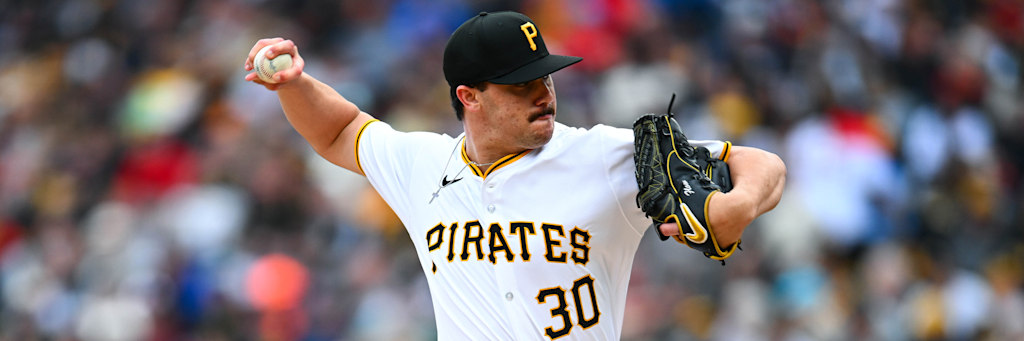
On July 19, Paul Skenes needed 100 pitches to get through seven innings against Cleveland. He allowed one run. He struck out eight. It was the kind of start that does not move his season ERA much, because his season ERA already sits at 3.43 with a 1.04 WHIP, a number that means Pittsburgh's ace puts a runner on base barely once an inning. Six days later, on regular rest, he faces a Cubs lineup that scored 42 runs in its last ten games in the widest possible distribution: an 11-run outburst against Detroit, a 1-run whimper the very next day. That volatility is the story of this board. Four unders survive a filter built on one number, WHIP, and three of them come from pitchers whose command is not in question. The fourth has to win a fight the building itself is rigged against.
The Framework: Baserunners Before Sequencing Gets A Vote
ERA is a sequencing-dependent number. A pitcher can allow four hits in an inning and post a zero if they come with two outs, or allow one and post a crooked number if it lands with the bases loaded. WHIP strips that variance out. It counts baserunners, full stop, and baserunners are the raw material every run distribution is built from. A starter sitting near or under a 1.10 WHIP is capping the number of chances an offense gets to sequence anything, regardless of how the runs eventually land on the scoreboard. That is the filter behind every play below: identify the pitcher suppressing baserunners at an elite rate, then check whether the market has priced the total as if he were an average one.
Every figure in the table below was pulled from the live season stat feed on the morning of July 25 and cross-checked against a second source before use. Three plays cleared the filter on pitcher command alone. The fourth clears it on command too, but has to survive a ballpark that fights the direction of the bet.
| Starter | ERA | WHIP | IP | K | Faces |
|---|---|---|---|---|---|
| Paul Skenes (PIT) | 3.43 | 1.04 | 115.1 | 138 | Cubs |
| Yoshinobu Yamamoto (LAD) | 2.78 | 0.88 | 119.2 | 113 | Mets |
| Nolan McLean (NYM) | 3.34 | 1.09 | 113.1 | 135 | Dodgers |
| Bryan Woo (SEA) | 4.16 | 1.09 | 110.1 | 109 | Rangers |
| Nathan Eovaldi (TEX) | 4.21 | 1.21 | 115.1 | 122 | Mariners |
Play One: Chicago Cubs Team Total Under 3.5, Minus 111
A minus-111 price on the Cubs scoring under 3.5 needs a 52.6 percent hit rate, and this is the play with the most tension in it, because the Cubs are not a quiet offense. They have scored 523 runs in 103 games this year, 5.08 a night, well above what the number implies. What the season line hides is how unevenly those runs have arrived. Across their last ten games the Cubs put up 0, 1, 2, 2, 5, 6, 6, 8, 10, and 11 runs, a stretch that includes four games under three runs and four games over five. That is not a lineup in a groove. It is a lineup on a streak of extremes, and Skenes is precisely the arm built to push a Cubs lineup toward its floor rather than its ceiling.
Here is the honest problem with this one. Pittsburgh's bullpen carries a 4.42 ERA, 22nd in the league, and it is not a hypothetical weakness. Two nights before this start, in the same series, Bubba Chandler threw six and a third scoreless innings only for Brandon Eisert and Yohan Ramirez to combine for two earned runs in an inning and two-thirds of relief. Skenes has thrown 100-plus pitches in his last several turns and pitches in a neutral park by run factor, 1.00, but his own bullpen has been the leak all month. If Skenes exits after six or seven and hands a lead to that group, this total is live. The projection still favors the under because Skenes controls the first two-thirds of the game and a below-1.10 WHIP starter facing a streaky lineup is the strongest single input on the board, but this is not a start-and-forget play.
Play Two And Three: The Yamamoto Matchup Against The Mets
Two of today's four positions come from the same pitcher, and both are defensible independently. Yoshinobu Yamamoto has a 2.78 ERA and a 0.88 WHIP through 119.2 innings, the best command line of anyone on this board, built increasingly around a splitter he now throws roughly 30 percent of the time. That pitch is generating a swing-and-miss rate above 40 percent and holding opponents to roughly a .150 average against it this season, and it is the reason his strikeout mix has shifted without his walk rate moving. The Mets, at 421 runs in 104 games for a 4.05 per-game average and a league-worst-tier .686 team OPS, sit at 43-61 and fifth in the NL East. This is not a lineup fighting through a slump. It is a lineup performing to its true talent level, which is modest.
The price, minus 145, is not cheap, and that is the honest read on why. The market already knows Yamamoto is elite and the Mets offense is thin, so the number reflects consensus rather than an inefficiency. The edge here is smaller than the other three plays and priced accordingly through unit size, not conviction. It is a lean, not an anchor.
The full-game total pairs Yamamoto's suppression with the Dodgers half of the equation, where Nolan McLean starts for New York. McLean has quietly become one of the better strikeout arms in the league, 135 punchouts in 113.1 innings against a 3.34 ERA, ninth among qualified starters in strikeouts. The Dodgers offense is the swing risk in this total. Los Angeles has scored 539 runs in 104 games, 5.18 a night, the strongest per-game output of any team on this board, and they carry that number into a game where their own offense is the primary threat to the under. McLean's command, a 1.09 WHIP, is solid but not in Yamamoto's tier, and his walk total, 41 in 113.1 innings, is the softest number in the pitcher table above.
Both plays are one opinion wearing two prices. If the Mets offense underperforms as projected, the team total cashes on its own, and the full-game total needs McLean to also hold serve against the best offense on the slate. Size the pair as a single view on this game rather than two independent edges.
Play Four: Mariners-Rangers Under 7.5, Minus 115, Fighting The Building
This is the play that has to win against its environment rather than because of it. Bryan Woo takes a 4.16 ERA and a 1.09 WHIP into Arlington, and Nathan Eovaldi counters at 4.21 and 1.21 across from him. Both are competent, command-forward starters, but neither is a suppression outlier the way Skenes or Yamamoto are. The offenses are modest on both sides, Seattle at 419 runs in 104 games and Texas at 432 in 103, both south of 4.2 runs a night. On paper, two average-command arms facing two average offenses projects toward a total in the 7-run range.
The honest counterpoint is the ballpark itself. Globe Life Field plays as a hitter-friendly building, with power and run factors north of 1.05, and its retractable roof has stayed closed for more than 80 percent of Rangers home games since it opened, trapping the Texas heat and humidity out rather than in and keeping the air dense enough to carry the ball. That is the opposite environment from PNC Park's neutral 1.00 run factor. Betting an under in a park engineered to boost offense, behind two starters whose ERAs sit in the low 4s rather than the low 3s, is the thinnest projection on this board. It survives the filter on the strength of two solid, sub-1.25 WHIP command lines and two offenses that have not scored at scale all year, but it is the one unit sized down for a reason, and the one play here I would drop first if the lineups come back weakened by a late scratch.
Sizing And The Ledger
Six units across four positions, and one correlation to respect: the Mets team total and the Dodgers-Mets full game total share a pitcher and a lineup, so treat them as one 3.5-unit opinion on Yamamoto's command holding up against a name-brand offense, not two independent edges. The Cubs play and the Mariners-Rangers play resolve on their own.
Stakes track command depth adjusted for the risk sitting behind each start. The Dodgers-Mets total gets the largest combined allocation because Yamamoto's 0.88 WHIP is the best number on the board. The Cubs team total is next, discounted half a unit below what the raw Skenes projection would suggest because Pittsburgh's bullpen has been actively bad this month. The Mets team total alone is a lean at a already-efficient price. The Mariners-Rangers under is the smallest stake on the card, a command bet fighting a building that wants the opposite outcome.
Every figure above, WHIP, ERA, innings, team runs and OPS, was pulled from the live season stat feed on the morning of July 25 and reconciled against a second source before the projections were finalized. The Skenes and Pirates bullpen lines were confirmed against play-by-play recap coverage from the last several days, not projected forward from season averages.