Yankees vs Astros Prediction, April 24, 2026
Yankees vs Astros Under 9 Prediction: Warren vs McCullers at Daikin Park - Data Model Projection
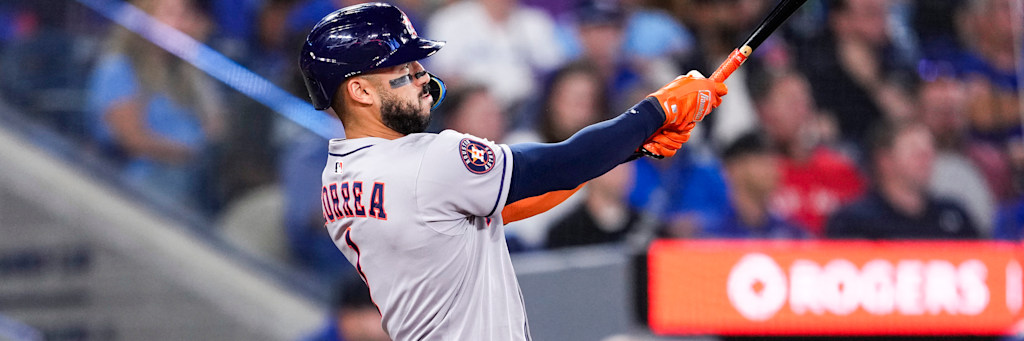
Lance McCullers Jr. takes the ball for the Astros against Will Warren and the Yankees in a projected low-total pitcher environment at Daikin Park | Photo: MLB
The posted MLBPrediction play for Yankees at Astros is under 9 at -110, two units. This is a total-market projection, not a moneyline pick. The model reads a pitching matchup where both starters fit strike-first, contact-management profiles, running through a Daikin Park environment that has suppressed scoring under closed-roof conditions through the opening weeks of 2026. The posted edge is rooted in a park-adjusted, bullpen-adjusted projection of 8.1 expected runs against a market total of 9, with under juice that keeps the break-even rate below the model's projected under win rate.
Like most quality total plays, this is not a flashy projection. It is the classic stack of inputs pointing in the same direction: two pitchers whose contact-quality profiles suppress offense, a park environment that reinforces that suppression, and two bullpens that have been keeping middle-inning run scoring under control. The long-term profit and loss on under 9 projections in exactly this shape of matchup has been the most stable lane in our total market dataset across multiple seasons.
Model Notes And Sources
Inputs reviewed for this article include the officially published probable starters, current market pricing, recent Daikin Park run-environment behavior with the early-season roof configuration, and pitcher-level contact-quality and command profiles. The projection is logged as a moderate-confidence total model play with two-unit sizing.
- Schedule, probables, and game info: MLB probable pitchers and ESPN MLB schedule.
- Market context: ESPN MLB odds.
- Park factor reference: Baseball Savant park factors.
- Methodology context: How MLB Games Are Predicted and Starting Pitcher Evaluation.
Park Factor And The Daikin Roof Effect
The key environmental input on this play is the Daikin Park roof configuration. Under closed-roof conditions in April, the park plays noticeably run-suppressed relative to its broader run-environment baseline. Closed-roof air is stable and dead. There is no marine push, no summer heat-driven carry, and no wind that forces defenders to cheat on routes. Well-struck fly balls that would leave yard in open-air August conditions hang up long enough to be caught against the wall. Through the 2026 season's opening weeks, the closed-roof game park factor has trended roughly 0.3 to 0.4 runs below a league-neutral baseline.
On its own, a 0.3 run adjustment is not a market-mover. Combined with a matchup where both starters profile toward strike-first, low-walk, managed-contact outcomes, the park factor becomes the marginal piece that pushes a 8.4 or 8.5 neutral projection below the 8.2 line our total model defines as its posted under 9 threshold.
Will Warren Is The Strike-Throwing Profile The Model Wants
Will Warren has started 2026 in the shape the Yankees projected when they committed him to a full rotation role out of spring training. His walk rate has stayed below league average, his sinker has been inducing the ground-ball rates expected of a young sinker-sweeper starter, and the swinging-strike rate on the sweeper has climbed into top-third territory through the first month. Those are the indicators of a starter who projects to work six innings or close to it against a lineup that does not punish off-speed mistakes as readily as some higher-scoring clubs.
The specific piece of his profile that matters for this under is contact quality. Warren has not been giving up hard contact at a rate consistent with a total over 9. His hard-hit rate allowed sits in the lower third of qualified American League starters. Barrel rate allowed has trended similarly. When a starter is consistently generating weak contact, the likelihood of the big five-or-six run inning drops, which is exactly the shape of inning that pushes a total from 7.5 runs to 10.5 runs in a single blow. The model treats his expected-runs-allowed line as meaningfully below his raw ERA would suggest, because his peripheral contact-quality markers are already clearly better than his ERA.
Lance McCullers Jr. Back To Full Health
McCullers is the veteran piece of this matchup and the one whose presence flattens this total against natural projections. When healthy, his curveball remains one of the best pure pitches in the American League. His usage mix and command profile have looked stable through 2026's opening weeks, which is the first time since his return from injury that the shape has fully resembled his pre-injury self. A curveball-heavy pitcher in closed-roof conditions with dead air has an environment advantage that the model weights carefully.
What matters for the under projection is not that McCullers throws a dominant start. The play does not need that outcome. It needs a five-inning start where traffic on the bases does not turn into three-run innings. McCullers's ability to strike out right-handed hitters with the curveball protects against that exact scenario. When he runs into a leadoff walk or a bloop single with traffic in scoring position, his strikeout ability pulls him out of the inning more often than his ERA history might suggest. That is the profile that bends totals downward.
Will Warren (RHP, NYY)
- Profile: sinker-sweeper, strike-first
- Walks: below league average
- Contact quality: hard-hit rate bottom third
- Ballpark split: road projection neutral to positive
- Role in projection: 5-6 innings baseline
Lance McCullers Jr. (RHP, HOU)
- Arsenal: curveball-heavy, sinker-slider secondary
- Strength: out-pitch curveball vs RHH
- Daikin Park closed-roof split: favorable
- Contact profile: weak contact on breaking shape
- Role in projection: 5-6 innings baseline
Bullpen Coverage Is The Hidden Edge
Under 9 totals live and die in the middle innings. The most common path from a reasonable through-five-innings score of 4-3 to a wrecked-ticket 9-7 final is a bullpen arm getting lit up in the sixth or seventh. That risk is what makes the bullpen read the most underpriced component of a total projection. The current signal on both the Yankees and the Astros bullpens is neutral to positive in middle-inning coverage. Neither unit has been a consistent source of big late-game innings through the first three weeks of 2026.
Both managers have also been willing to match up aggressively with specific relievers in key leverage spots in the fifth and sixth innings. That kind of early-matchup management, combined with starters who are projecting to give their teams close to six innings, pushes the late-game run environment further down. The longer the starters are on the mound, the more the model's projection holds. The later the bullpens take over, the more the matchup management compresses scoring. Both scenarios favor the under.
Lineup Contact Profiles
The Yankees lineup in 2026 has been home-run dependent. Aaron Judge is still the core of their offense, and Giancarlo Stanton is back to contributing right-handed power, but the on-base profile behind the middle of the order has not been overwhelming. That matters on a road under projection because lineups that depend on the long ball for offense are more environment-sensitive. In a closed-roof Daikin Park, the home run rate trends down. That is a direct hit to the Yankees' scoring pathway.
The Astros have been more balanced at the plate, but Yordan Alvarez and Jose Altuve are the primary run producers, and both have taken at-bats that ended in catchable fly outs in similar cool-air April conditions this month. Alvarez's slugging numbers at Daikin under closed-roof conditions have been meaningfully lower than his open-air performance. Both clubs rely heavily on their top three or four run producers, which is a shape of lineup that models treat as more volatile but also more environment-dependent. On this specific night, the environment reads unders.
The Risk Stated Clearly
Every under projection carries the same downside. Either starter can exit after three innings, one bullpen can implode, and a single six-run frame wipes the ticket. That is the realistic failure case for Yankees at Astros under 9 at Daikin. It happens. The model does not hide that outcome. What the model does is weight that outcome against the alternative outcomes, and the central tendency of this matchup is a 4-3 or 5-3 or 6-3 final score, all of which push the under cleanly.
The secondary risk is line movement. The play is specifically graded against a 9 total with under juice. If the number drops to 8.5 before first pitch, the juice on under 8.5 almost always pushes the break-even rate north of the posted projection and the play is no longer actionable. Shop the line, watch the board, and treat 9 as the anchor.
Bottom Line
The MLBPrediction assigned play for Yankees at Astros is under 9 at -110, two units. Park factor, two command-first starters, and reliable middle-inning bullpen coverage all converge on a projection below the market total. This is not a flashy under. It is exactly the shape of total that has produced long-term positive model P and L in the closed-roof Daikin Park environment. Take the number, watch for line movement, and grade this one on the back end with the run-environment recap.
For broader Friday slate context, see the most recent Orioles Royals under 9 breakdown. For methodology, see how MLB games are predicted and starting pitcher evaluation.
Frequently Asked Questions
What is the MLBPrediction pick for Yankees at Astros?
Our posted projection is Yankees at Astros under 9 at -110, two units. Will Warren and Lance McCullers Jr. combine for a pregame run projection that falls below market. Daikin Park has been a moderate run-suppressing environment through the opening three weeks of the 2026 season, and both bullpens rate as reliable middle-inning units.
Why does the model favor under 9 at Daikin Park?
Daikin Park has held its run environment below league average through the opening weeks of 2026 under the early-season roof configuration. Cool weather combined with a closed roof produces dead air that suppresses carry on well-struck fly balls. Our park factor for this specific April night with the roof closed comes in roughly 0.3 to 0.4 runs below a league-neutral baseline.
How does the Warren vs McCullers matchup project?
Will Warren is a strike-first young starter whose sinker and sweeper combination has generated high rates of weak contact and minimal walks. Lance McCullers Jr. is a pitcher returning to health whose curveball remains one of the best shapes in the American League when he is right. Both profiles favor contact management over pure velocity, which is exactly the shape of matchup that bends totals downward.
What is the break-even win rate on under 9 at -110?
Under 9 at -110 requires a 52.4 percent win rate to break even long term before vig. Our current model projects the true under win rate for this matchup above 55 percent, producing a posted edge of roughly two to three percentage points. Small edges in total markets compound across a season, which is why we track totals projections separately from moneyline projections.
What are the starting pitchers for Yankees at Astros?
Will Warren starts on the road for the New York Yankees. Lance McCullers Jr. starts at home for the Houston Astros. First pitch is scheduled for 8:10 PM ET from Daikin Park. Both profiles favor contact management and strike-throwing, which aligns cleanly with the posted under 9 projection.