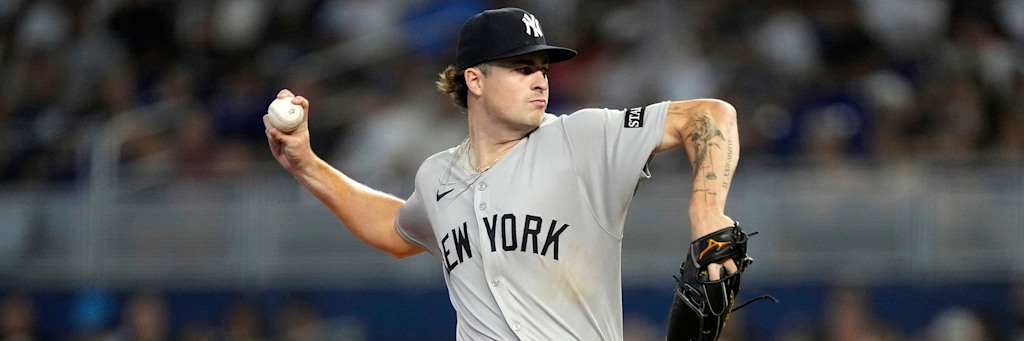
Two starting pitchers define the entire June 25 projection, and both grade in the top tier of every input the model weights. Cam Schlittler carries a 1.71 ERA and a 10.33 strikeouts-per-nine rate; Cristopher Sanchez owns a 1.80 ERA, a 1.09 WHIP, and 121 strikeouts across 105 innings. When two arms suppress baserunners that aggressively on the same slate, the cleanest outputs are not the moneylines but the team totals attached to the offenses standing in against them. The model's two anchor positions are the Red Sox team total under 3.5 and the Nationals team total under 3.5.
The Framework: Strikeout Rate And WHIP As Twin Suppression Inputs
A team-total projection reduces to a single question: how many runs can this one offense plausibly manufacture against this one starter and the bullpen behind him. Two pitcher inputs answer most of it. Strikeout rate caps the ceiling, because a strikeout is the lone outcome with a run expectancy of zero and it removes the productive-out and the rally-extending contact at once. WHIP measures the baserunner supply, because runs are a function of traffic and a starter who keeps the bases empty starves an offense of the sequences that produce crooked numbers. When a starter grades elite on both, the opposing club's projected run column collapses toward the low end, which is exactly where a team total set at 3.5 lives. The June 25 board offers two starters who clear both thresholds against two of the weaker offenses on the slate, and that overlap is what pushes the model to the team-total unders ahead of everything else.
Red Sox Team Total Under 3.5: The Schlittler Signal
| Team | Probable starter | Key inputs |
|---|---|---|
| Yankees | Cam Schlittler (RHP, 8-3, 1.71 ERA, 10.33 K/9) | Elite bat-missing, two prior wins over Boston |
| Red Sox offense | Boston, 32-46 entering the day | Bottom-tier run production, faces a top-five arm |
Schlittler is the most important variable on the slate. A 10.33 strikeouts-per-nine rate paired with a 1.71 ERA describes a starter who removes more than a strikeout per inning while allowing almost nothing on the contact he permits. Run that profile against a Boston offense sitting at 32-46, one of the league's quieter run-scoring units, and the projected Red Sox run column lands well under its season baseline even at home. Boston has already failed to solve Schlittler twice this year, which is a small but directionally useful prior. The model treats the Red Sox team total under 3.5 as its highest-conviction output, because a team total isolates the exact run column the starter most directly controls and strips out the noise of how many runs New York scores on the other side.
The model does not ignore the counterweight. Connelly Early is a capable Boston starter at a 3.64 ERA, so the game is unlikely to be a track meet in either direction, and Fenway Park can convert a single mistake into extra-base damage in a way that pressures any team-total under. That park factor is why the line sits at 3.5 rather than 2.5, and it is the chief failure mode. But the projection question is narrow: can a bottom-third offense reach four runs against a 1.71-ERA arm with double-digit strikeout stuff before the bullpen takes over. The median says no.
Nationals Team Total Under 3.5: The Sanchez Signal
| Team | Probable starter | Key inputs |
|---|---|---|
| Phillies | Cristopher Sanchez (LHP, 9-3, 1.80 ERA, 1.09 WHIP, 121 K) | Sub-1.10 WHIP, 105 innings of front-line work |
| Nationals offense | Washington, hosting at Nationals Park | Below-average run production vs an elite lefty |
Sanchez is the companion anchor, and his 1.09 WHIP is the number that drives the Nationals team total under 3.5. A sub-1.10 WHIP means roughly one baserunner per inning, which is the rate at which an offense almost never strings together the multi-hit sequences a team total of 3.5 requires. Pair that with a 1.80 ERA and 121 strikeouts, and Washington's projected run column compresses to the low threes at most. The Phillies are 11-5 when Sanchez starts, which is the team-level expression of the same suppression the model reads at the pitch level. Because a team total isolates the Washington offense from the scoreboard entirely, this is the lowest-variance way to express the Sanchez edge, and the model ranks it just beneath the Red Sox under.
The honest adjustment is that Cade Cavalli has kept the Nationals in games, allowing three earned runs or fewer in 14 of his 16 starts, so Washington does not need a big night to stay close on the scoreboard even if its own bats go quiet. That keeps the moneyline projection tighter than the team-total projection, which is precisely why the model prefers the under on the Washington run column over the side. The bet is on suppression, not on the final result.
Astros Tigers Under 9: A Low-WHIP Tiger At Comerica
| Team | Probable starter | Key inputs |
|---|---|---|
| Tigers | Troy Melton (RHP, 4-0, 2.56 ERA, 0.947 WHIP) | Elite early-season WHIP in a pitcher-leaning park |
| Astros | Tatsuya Imai (RHP, rookie, command-volatile) | High strikeout upside, wide walk-rate band |
The Astros and Tigers under 9 is the model's most park-and-arm-driven game total. Troy Melton has been excellent in his early body of work, a 2.56 ERA backed by a 0.947 WHIP, the kind of baserunner suppression that compresses the Houston run column hard. Comerica Park is a roomy environment that historically dampens run scoring, which adds a second suppression factor on top of the arm. The Houston-allowed side is the looser half of the projection, because rookie Tatsuya Imai brings genuine strikeout upside but a wide command band, and a walk-prone outing can lift the Detroit run column. The under 9 line accommodates exactly that uncertainty.
The model treats this as a directional read rather than a top-conviction output, and the reason is structural: a full-game total carries a fatter tail than a team total because it stacks the variance of two run columns rather than one. Even granting Imai a noisy projection, Melton's 0.947 WHIP caps the Houston side firmly enough that the combined median lands below 9, with the park doing supporting work. The same matchup also produces a token plus-money Astros moneyline output, a low-stake side play where even money on a road club with a strong lineup is a fair coin flip, but the cleaner expression of the matchup is the under.
The Full Projection Board
Beyond the three suppression outputs, the model touches the rest of the slate, each sorted by the width of its projected edge and the variance of the bet type.
| Projection | Line | Primary input |
|---|---|---|
| Red Sox team total under | 3.5 | Schlittler 10.33 K/9, 1.71 ERA |
| Nationals team total under | 3.5 | Sanchez 1.09 WHIP, 1.80 ERA |
| Astros/Tigers game total under | 9 | Melton 0.947 WHIP, Comerica park factor |
| Yankees moneyline | vs Red Sox | Schlittler edge over Early, 48-31 club |
| Phillies moneyline | at Nationals | Sanchez 1.80 ERA over Cavalli's 1.46 WHIP |
| Blue Jays moneyline | vs Rangers | Gausman 1.14 WHIP home edge over Gore |
| Giants moneyline | vs Athletics | Roupp over Springs' 5.55 ERA at home |
The moneyline outputs are real but carry wider distributions than the team totals. The Yankees and Phillies sides are the same Schlittler and Sanchez signals expressed as win probability rather than as a contained run column, and a win probability inherits all the noise of bullpen sequencing and the opposing offense. The Blue Jays moneyline resolves on Kevin Gausman's 1.14 WHIP and home-field edge over MacKenzie Gore's higher 1.30 WHIP, a narrower margin the model rates as a lean. The Giants moneyline is a matchup output: a 32-46 record that depresses the price against an Athletics starter carrying a 5.55 ERA, which the model reads as priced too cheaply on the better arm.
How The Model Sizes Each Output
Conviction is a function of two things: the gap between the projection and the market line, and the variance of the bet type. Team totals are the lowest-variance outputs on this board, because they isolate a single offense against a single dominant starter, so the Red Sox and Nationals unders sit at the top of the order. Full-game totals occupy higher ground on the variance curve, which places the Astros and Tigers under 9 a tier below as a directional read. Moneylines inherit the widest distributions of all, since a win probability folds in both run columns plus bullpen and sequencing noise, so they are sized beneath the suppression plays. The model favors the side it projects, but favored is a probability, and the sizing logic respects that the wider the distribution, the lighter the lean.
What Beats It
A single multi-run inning beats the suppression board. The team-total unders assume Schlittler and Sanchez hold their strikeout and WHIP profiles deep into the start; the night either exits early, the opposing bullpen inherits the run column and the under comes under pressure. The Red Sox under is most exposed to a Fenway extra-base swing, and the Nationals under loses if Washington strings together a rare multi-hit sequence against Sanchez. The Astros and Tigers under is the night Imai's walks and a Detroit rally push the total over 9. The moneylines fall to quiet offenses or a starter clunker. Lineups were not all confirmed at publication, so the projections assume listed regulars. The model is favored on its outputs, but favored is a probability, not a result.
Final Verdict
The June 25 projection model outputs the Red Sox team total under 3.5 and the Nationals team total under 3.5 as its anchor pair, both driven by elite bat-missing and baserunner suppression from Cam Schlittler and Cristopher Sanchez, with the Astros and Tigers under 9 behind Troy Melton's 0.947 WHIP as the sharpest game-total read. The throughline is run prevention measured through strikeout rate and WHIP, with Comerica Park the lone environmental adjustment. For more model work, see the advanced stats hub, the latest projections, and the prediction archive.
Picks and odds come from the BetLegend daily tracker. Probable starters, records, matchups, and venues were verified against MLB Stats API data for June 25, 2026.
Related Projection Models
More daily run-prevention and run-suppression reads built on the same strikeout-rate, WHIP and park-factor framework:
- June 26 run-suppression model: Cubs and Padres team total unders
- June 24 run-prevention model: Twins under on Ohtani and an Orioles under
- June 23 contact-suppression model: Guardians edge, Astros and Giants unders
- June 22 strikeout-rate model: Guardians under, Brewers and Yankees edges
For the inputs behind every projection, read how the MLB prediction model works, and review the model's public track record and graded results.