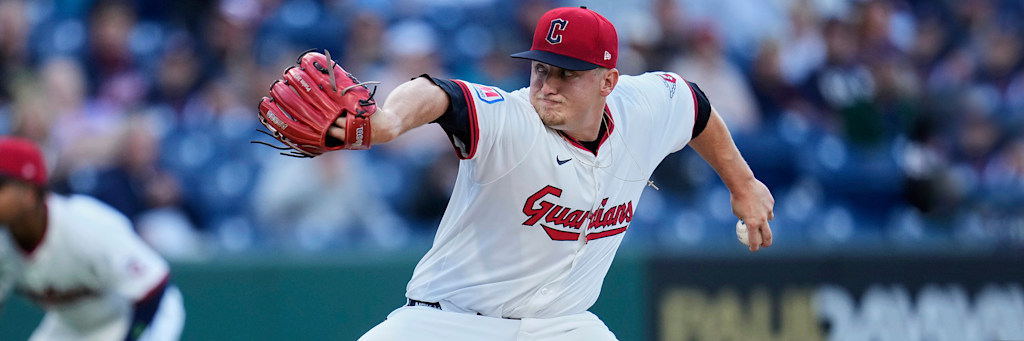
One profile anchors the entire June 23 projection, and it belongs to Parker Messick: a 9.45 strikeouts-per-nine rate paired with a .215 opponent batting average across 86.2 innings. Those two numbers describe a starter who removes more than a strikeout per inning from the run-scoring distribution and holds the rest of the league to a sub-.220 line on contact. Feed that into a win-probability model against a back-half White Sox offense and the Guardians moneyline becomes the cleanest output on the board.
The Framework: Strikeout Rate And Opponent Average As Twin Inputs
A run-projection model reduces to two probabilities: how often a plate appearance produces a baserunner, and how often baserunners convert to runs. Strikeout rate attacks the first directly, because a strikeout is the lone batted-ball outcome with a run expectancy of zero. Opponent batting average attacks the second, by measuring how much damage a pitcher allows on the contact he does permit. When a starter grades highly on both, the projected run column narrows and the edge against an inflated total or an underpriced moneyline widens. The June 23 board is unusually dense with arms that clear both thresholds, which is what pushes the model toward run prevention across the slate.
Guardians Moneyline: The Messick Suppression Signal
| Team | Probable starter | Record |
|---|---|---|
| Guardians | Parker Messick (LHP, 7-3, 2.70 ERA, 9.45 K/9, .215 BAA) | 41-38 |
| White Sox | Sean Burke (RHP, 4-4, 3.89 ERA, 9.00 K/9) | 40-37 |
Messick is the single most important variable on the slate. A 9.45 strikeouts-per-nine rate sits comfortably in the upper tier of starters, and the .215 opponent average confirms that the contact he allows is weak. The model projects the Chicago run column well below its season baseline at Rate Field, because the strikeout volume erases the high-leverage at-bats where the White Sox would otherwise manufacture runs. That suppression is the core of the Guardians moneyline edge, and it carries into the White Sox team total under 3.5 as the same signal expressed as a contained bet on Chicago's run column alone.
Sean Burke supplies a real counterweight, and the model does not ignore it. Burke is 4-4 with a 3.89 ERA and a 9.00 strikeouts-per-nine rate of his own, which is why the Guardians moneyline projects as a near-pickem edge rather than a blowout. Two strikeout arms in the same game tightens the projected run environment for both clubs, and the model resolves the matchup on the margins: Messick's lower opponent average and superior ERA push Cleveland past the implied break-even, while the overall bat-missing on both sides keeps the White Sox team total capped.
Astros Blue Jays Under 9: Lambert And A Returning Bieber
| Team | Probable starter | Record |
|---|---|---|
| Astros | Peter Lambert (RHP, 6-4, 3.23 ERA, .199 BAA, 1.11 WHIP) | 37-43 |
| Blue Jays | Shane Bieber (RHP, returning to the rotation) | 39-39 |
The Astros versus Blue Jays under 9 is the model's most park-and-arm-driven total. Peter Lambert has been quietly excellent at a 3.23 ERA with a .199 opponent batting average and a 1.11 WHIP, an elite weak-contact line that the strikeout-and-contact framework rates highly. A .199 opponent average means hitters rarely square Lambert up, and the projected Toronto run column compresses accordingly. He draws Shane Bieber, who is working his way back into the Toronto rotation, which introduces the chief uncertainty on this leg.
The model treats the Bieber side with care because a pitcher returning to a rotation carries a wider projection band: the established track record argues for run suppression, but the recent workload and command are unsettled. The under 9 line accommodates that uncertainty, which is the point. Even granting Toronto a soft projection on the Bieber half, Lambert's .199 opponent average caps the Houston-allowed runs hard enough that the combined total projects below 9. The variance on a full-game total is wider than on a team total, which is why this output is a directional read rather than the board's heaviest conviction.
Giants Athletics Under 9: A Bat-Missing Lefty At A Pitcher's Park
| Team | Probable starter | Record |
|---|---|---|
| Giants | Robbie Ray (LHP, 5-6, 4.07 ERA, 8.36 K/9, 74 K) | 31-46 |
| Athletics | Aaron Civale (RHP, 5-3, 4.91 ERA, .306 BAA) | 38-40 |
The Giants versus Athletics under 9 leans on two inputs the model weights heavily: a bat-missing starter and a run-suppressing venue. Robbie Ray brings an 8.36 strikeouts-per-nine rate and 74 strikeouts to Oracle Park, one of the most consistent pitcher-friendly environments in the sport. The strikeout rate compresses the Athletics run column, and the marine layer in San Francisco does the rest by knocking down fly balls that leave other yards. That combination is the textbook recipe the under-projection framework is built to catch.
Aaron Civale is the wrinkle, and the model is honest about him. Civale carries a 4.91 ERA and a .306 opponent batting average, a high-contact line that ordinarily pulls a total toward the over. But the relevant question for the Giants run column is whether San Francisco's offense, sitting at 31-46, can capitalize on that soft arm before the Oracle Park environment caps the damage, and the projected median says it falls short of a true over push. The net is a combined total that lands under 9, with Ray's strikeout rate and the park doing more to suppress the Athletics side than Civale's contact profile adds to the Giants side.
The Full Projection Board
Beyond the four headline outputs, the model touches the rest of the slate, each sorted by the width of its projected edge and the variance of the bet type.
| Projection | Line | Primary input |
|---|---|---|
| Guardians moneyline | vs White Sox | Messick 9.45 K/9, .215 BAA |
| White Sox team total under | 3.5 | Messick contact suppression on the Chicago run column |
| Astros/Blue Jays game total under | 9 | Lambert .199 BAA, Bieber rotation return |
| Giants/Athletics game total under | 9 | Ray 8.36 K/9 at Oracle Park run-suppression factor |
| Marlins moneyline | vs Rangers | Alcantara 103.1 IP workload, 1.24 WHIP |
| Rays moneyline | vs Royals | McClanahan 9.18 K/9, .218 BAA at Tropicana Field |
| Mariners moneyline | at Pirates | Kirby 79 K rotation edge over a .500 club |
The Rays moneyline is a win-probability output where the dominant input is Shane McClanahan's 9.18 strikeouts-per-nine rate and .218 opponent average paired with the run-suppression factor of Tropicana Field. The counterweight the unsophisticated model overweights is the opposing record; Kansas City sits at 33-46 and starts Luinder Avila, whose 1.65 WHIP signals a baserunner-prone outing. The properly specified projection holds Tampa Bay above the implied break-even because the strikeout-and-contact edge compounds with the park.
How The Model Sizes Each Output
Conviction is a function of two inputs: the gap between the projection and the market line, and the variance of the bet type. Single-club moneylines against weaker opponents and team totals are the lowest-variance outputs, which is why the Guardians moneyline and the White Sox team total under sit at the top of the conviction order. Full-game totals occupy higher ground on the variance curve, because a nine-inning run distribution has a fatter tail than a single club's run column, so the Astros/Blue Jays and Giants/Athletics unders are directional reads held below the headline conviction. The model favors the side it projects, but favored is a probability, and the sizing logic respects that the wider the distribution, the lighter the lean.
The Honest Counterpoint
A projection is a distribution, not a verdict, and the model names its own failure modes. The Messick-anchored Guardians edge depends on him holding his strikeout rate; a short outing hands Cleveland's bullpen the game early and erodes both the moneyline and the White Sox team total signal at once. The Astros/Blue Jays under carries the specific uncertainty of Bieber's rotation return, a wider band than a settled starter. The Giants/Athletics under leans on Oracle Park behaving as its factor table says, and Civale's .306 opponent average is a live over threat if San Francisco's offense wakes up. Lineups were not all confirmed at publication, so the projections assume listed regulars. A framework that respects variance accounts for each of these in the conviction order.
What Beats It
A single multi-run inning beats the run-prevention board. The projection assumes the starters hold their strikeout and contact-suppression profiles; the night a top arm leaves early, both the team total and the game total come under pressure at once. The moneylines fall to quiet offenses or a starter clunker. The Astros/Blue Jays under is the most exposed because of the Bieber rotation-return uncertainty, and the Giants/Athletics under loses if Civale's high opponent average finally catches up to him at home. The model is favored on its outputs, but favored is a probability, not a result.
Final Verdict
The June 23 projection model outputs the Guardians moneyline and the White Sox team total under 3.5 as its anchor pair, both driven by Parker Messick's 9.45 strikeouts-per-nine rate and .215 opponent average, with the Astros Blue Jays under 9 and the Giants Athletics under 9 as the sharpest game-total reads. The throughline is run prevention measured through strikeout rate and weak contact, with Oracle Park and Tropicana Field the lone environmental adjustments. For more model work, see the advanced stats hub, the latest projections, and the prediction archive.
Picks and odds come from the BetLegend daily tracker. Probable starters, records, matchups, and venues were verified against MLB Stats API data for June 23, 2026.
Related Projection Models
More daily run-prevention and run-suppression reads built on the same strikeout-rate, WHIP and park-factor framework:
- June 24 run-prevention model: Twins under on Ohtani and an Orioles under
- June 22 strikeout-rate model: Guardians under, Brewers and Yankees edges
- June 25 run-suppression model: Red Sox and Nationals team total unders
- June 21 expected-runs model: Athletics Angels over and a Cardinals moneyline
For the inputs behind every projection, read how the MLB prediction model works, and review the model's public track record and graded results.