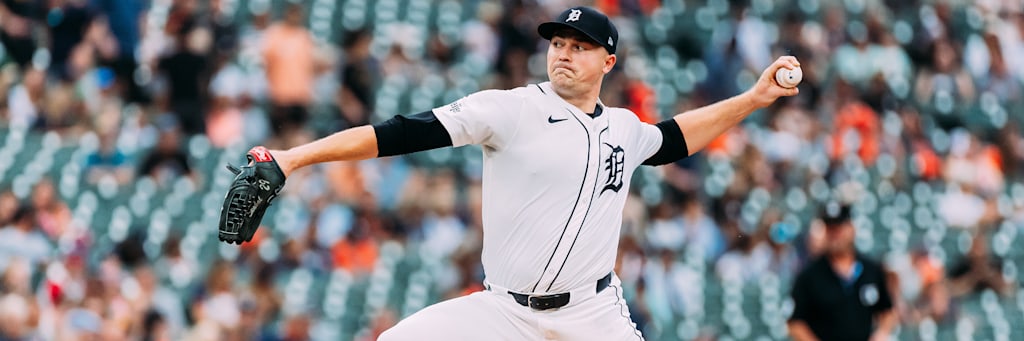
The Tuesday board reads as a study in strikeout rate. The model frames each game as a projected distribution of runs rather than a winner, and on June 30 the swing-and-miss inputs dominate every other variable. Four of the six outputs are run-suppression plays driven by a starter who misses bats, and the two moneylines that round out the card win on the same logic from a different angle. The thread is not a feeling about who covers. It is where the median run total lands once you weight the most predictive input the model owns: how often the man on the mound takes the bat out of the equation entirely.
The Framework: Strikeout Rate As The Run-Suppression Engine
A run-environment model answers a narrow question before anything else. Given this park, this starter and this lineup, where does the median run total land, and how wide is the band around it. Strikeout rate is the single most important input, because a strikeout carries a run expectancy near zero and removes the ball in play, the most dangerous outcome, from the distribution. Park factor sets the baseline, lineup depth sets the width of the tail, and WHIP measures how often a starter even allows the traffic that scoring requires. The reason four of today's six outputs are unders or team totals is that isolating run prevention is the lowest-variance bet shape on a slate where the best arms are concentrated on one side of several matchups. The outputs below are ranked by the gap between the model line and the market, adjusted for the variance each bet type carries.
Tigers-Yankees Under 7: Two Aces, The Narrowest Band On The Board
| Item | Model detail |
|---|---|
| Run environment | Full game, Yankee Stadium |
| Starters | Tarik Skubal (3.32 ERA, 0.99 WHIP, 66 K) vs Cam Schlittler (1.62 ERA, 0.92 WHIP, 118 K) |
| Records | Tigers 36-49, Yankees 48-36 |
| Model line | Under 7 (-105) |
This is the cleanest full-game suppression input on the slate, and it is rare because both sides supply it. Tarik Skubal takes the ball with a 3.32 ERA and a 0.99 WHIP, a starter allowing fewer than one baserunner per inning, and Cam Schlittler answers with an 8-4 record, a 1.62 ERA, a 0.92 WHIP and 118 strikeouts. When the model finds two arms that both erase traffic at this rate, the projected distribution for the whole game collapses toward a low number, because neither offense gets the free baserunners that crooked innings are built from. The Tigers at 36-49 bring a below-average bat into the equation, which lowers the ceiling further, and the result is a median full-game total that lands under 7 with a narrow band on either side.
The honest counterweight is that a full-game under exposes you to both offenses at once, so a single mistake from either ace reopens the distribution. A 48-36 Yankees lineup can punish one hanging pitch, and a 3-2 game can become a 5-3 game on two swings. But the band here is the tightest on the card precisely because both starters suppress, which is why this sits on top of the ranking rather than a team total.
Angels Team Total Under 3.5: One Quiet Bat In A Pitcher's Park
| Item | Model detail |
|---|---|
| Run column | Los Angeles Angels offense, at T-Mobile Park |
| Opposing starter | Bryan Woo (RHP), 4.26 ERA, 1.04 WHIP, 92 K |
| Records | Angels 36-50, Mariners 43-43 |
| Model line | Team total under 3.5 (-150) |
The second isolation play strips the matchup down to one run column. The Angels arrive at 36-50 with one of the weaker offenses on the slate, and they walk into T-Mobile Park, a venue that has historically held totals down before a pitch is thrown. Seattle counters with Bryan Woo, whose 1.04 WHIP says he keeps the bases clean even when his 4.26 ERA suggests the occasional mistake. Stack a low-baserunner arm in a suppressing park against a struggling road bat and the projected median for the Angels run column lands below four. The model outputs the team total under 3.5 at -150 because park, opponent and lineup quality all agree from different directions.
The price is the catch. At -150 the under needs to clear 60 percent to beat the vig, the steepest break-even on the card, which is why this ranks behind the two-ace under despite a clean projection. A team total under always carries the one-swing risk, where a single three-run inning busts the number before the bullpen ever appears, and a -150 tag leaves less margin for that variance. The model includes it because the inputs are emphatic, but the juice keeps it a notch below the headline.
Pirates Team Total Under 3.5: Sanchez Is The Suppression
| Item | Model detail |
|---|---|
| Run column | Pittsburgh Pirates offense, at Citizens Bank Park |
| Opposing starter | Cristopher Sanchez (LHP), 2.13 ERA, 1.11 WHIP, 127 K |
| Records | Pirates 43-42, Phillies 47-38 |
| Model line | Team total under 3.5 (-135) |
The third output is the model trusting an elite arm over a road park that can play big. Cristopher Sanchez is the best starter on the entire slate by the run-prevention metrics, sitting at 9-3 with a 2.13 ERA, a 1.11 WHIP and 127 strikeouts, a left-hander who misses bats and limits traffic in equal measure. The Pittsburgh offense at 43-42 is an average unit, the kind of lineup the model projects to be quieted by a sub-2.20 ERA arm even inside a hitter-friendly venue. The result is a projected Pirates run column that sits below four, and the team total under 3.5 at -135 captures it without caring how Philadelphia scores on the other side.
The variance note is identical to every team total under: one swing can clear the number, and an average offense is still a major league offense capable of a loud inning. But the suppression input here is the strongest on the board on the opposing-starter axis, which is why the model ranks it above the standings-driven plays even with the one-swing tail in the projection.
Giants-Diamondbacks Under 9: A Weak Road Bat Caps The Distribution
| Team | Key input | Records |
|---|---|---|
| Giants offense | 35-49, one of the quietest lineups on the slate | SF 35-49 |
| Diamondbacks side | Landen Roupp (RHP), 4.07 ERA, 1.29 WHIP, 95 K on the visiting arm | ARI 42-42 |
The fourth suppression output is a full-game under driven by one anemic offense. San Francisco brings a 35-49 record and a bottom-tier run-scoring profile into Arizona, and the model treats a weak road bat as a hard ceiling on the projected total. Landen Roupp gives the matchup a competent arm at a 4.07 ERA and a 1.29 WHIP, enough to keep the Giants from inflating the number even in a park that can play offensively. With one side of the equation projecting low almost regardless of how Arizona scores, the under 9 at -115 lands as a directional lean rather than an anchor.
This ranks below the team totals because a full-game under leans on both offenses cooperating, and Arizona at 42-42 is a more capable bat than San Francisco. A single productive Diamondbacks inning can carry the total toward the number on its own, which widens the band. The model keeps it as a 1.5-unit lean because the Giants ceiling is genuinely low, but the two-sided exposure earns it a middle slot.
The Two Moneylines: Where Projection And Standings Agree
Two side bets close the card, each a game where the model's win-probability output sits above the implied price and the standings reinforce it.
| Output | Line | Primary input |
|---|---|---|
| Dodgers moneyline | -167 | Wrobleski 2.71 ERA vs Springs 5.52 ERA, 55-30 club |
| Brewers moneyline | -161 | 51-31 roster outclasses a 39-44 Reds club |
The Los Angeles output is the strongest moneyline on the board. The Dodgers at 55-30 own the best record in the sport, and Justin Wrobleski at a 2.71 ERA and a 1.01 WHIP gives the projection a run-prevention edge to layer on top of the talent gap, against an Athletics club sending Jeffrey Springs and a 5.52 ERA. The Milwaukee output is a roster-quality read rather than a pitching one: with Brandon Sproat at a 5.43 ERA and Rhett Lowder at a 4.81 ERA canceling out on the mound, the model leans on the gap between a 51-31 Brewers club and a 39-44 Reds club, where bullpen depth and lineup quality decide a starter-neutral night. Both are side bets, which carry the fattest tail on the card because a single swing settles the result outright, so they anchor the bottom of the ranking despite clean win-probability edges.
The Full Model Card, Ranked
| Rank | Output | Line | Why it ranks here |
|---|---|---|---|
| 1 | Tigers/Yankees under | 7 (-105) | Two aces, narrowest band, near-even price |
| 2 | Angels team total under | 3.5 (-150) | Quiet bat, suppressing park, but steep juice |
| 3 | Pirates team total under | 3.5 (-135) | Strongest opposing-starter input on the board |
| 4 | Giants/Diamondbacks under | 9 (-115) | Low Giants ceiling, two-sided exposure |
| 5 | Dodgers moneyline | -167 | Best record plus a run-prevention edge |
| 6 | Brewers moneyline | -161 | Roster edge, but a side bet's fat tail |
That order tracks distribution width, not preference. The Tigers-Yankees under leads because two suppressing arms collapse the band and the price is near even. The Angels and Pirates team totals follow as single-column isolation plays, separated by their juice. The Giants under carries two-sided exposure, and the two moneylines anchor the bottom because a side bet flips on one swing. Favored is a probability across all six, and the sizing should track the spread of each projection rather than the confidence of the headline.
What Beats This Card
A single crooked inning beats a run-prevention board every time. The Tigers-Yankees under loses if either ace hangs one and a 48-36 Yankees lineup turns a grind into a track meet. The Angels under at -150 leaves little margin, so one Los Angeles rally against Bryan Woo busts it. The Pirates under falls to one swing from an average bat, the Giants under needs Arizona to stay quiet, and the two moneylines each carry the plain truth that any favorite loses outright more often than its price admits. Lineups were not all confirmed at publication, so the projections assume listed regulars and probable starters. The model is favored on its outputs, but favored is a probability, not a result.
Final Verdict
The June 30, 2026 model breakdown outputs the Tigers-Yankees under 7 as its anchor, a pair of bat-missing aces collapsing the projected distribution to its narrowest band. The Angels team total under 3.5 and Pirates team total under 3.5 follow as single-column isolation plays, separated only by their juice, and the Giants and Diamondbacks under 9 adds a low-ceiling road bat. The Dodgers moneyline at -167 pairs the best record in baseball with a run-prevention edge, and the Brewers moneyline at -161 is the roster-quality side bet. The through-line is strikeout rate measured through park factor and bet-type variance. For more model work, see the June 29 run-prevention model, the advanced stats hub, the daily MLB breakdown picks, and the MLB futures board.
Related Model Breakdowns
More daily run-environment reads built on the same strikeout-rate and run-distribution framework:
- June 29 run-prevention model: Rangers and Dodgers unders and a Mariners run line
- June 27 run-prevention model: Braves under and a Giants win-probability edge
For the inputs behind every projection, read how the MLB prediction model works, and review the model's public track record and graded results.