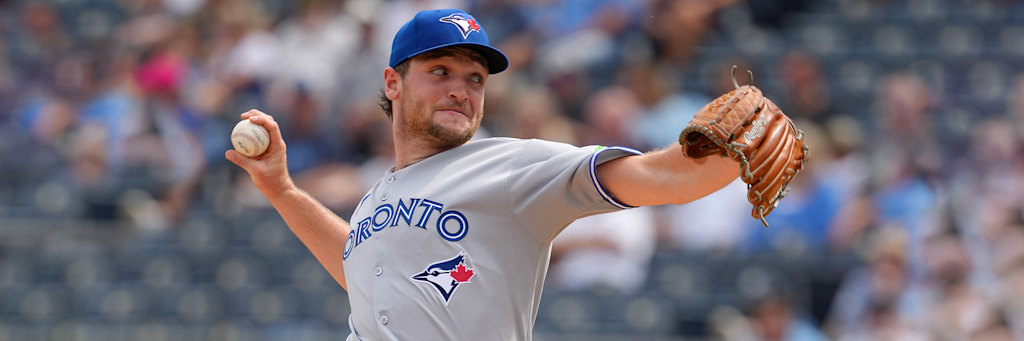
Twice a season, maybe three times, the two tightest traffic inputs on a full slate land in the same game. It happens on July 5 at T-Mobile Park. Emerson Hancock owns a 1.05 WHIP, built on 22 walks in 90.2 innings, the best baserunner rate of the twelve scheduled starters on this card. Trey Yesavage sits right behind him at 1.10, and he brings the single hardest input to hit on the board, a .185 opponents batting average. When both distributions in one game compress like that, and the two lineups feeding them rank near the bottom of the card in scoring, the model does not hesitate. The Blue Jays-Mariners under 7.5 is the top output of the day, and everything else on the board is ranked beneath it by the same two-term equation.
The Framework: Traffic Times Conversion
Runs decompose into two measurable terms. The first is traffic, how many runners the opposing starter puts on, which WHIP, opponents average and walk rate capture directly. The second is conversion, how efficiently a lineup turns its traffic into runs, which shows up in runs per game, batting average and OPS at the season scale. Most daily models obsess over the first term and treat the second as noise. This board punishes that habit, because the conversion spreads are enormous: Milwaukee turns its opportunities into 5.13 runs a game while Cleveland manages 3.96 from an identical count of outs. Each projection below multiplies the two terms for both sides of a game, compares the resulting distribution to the market number, and ranks the seven outputs by the size of the gap. Conversion data for the card's key lineups sits in one table.
| Lineup | Runs/game | Team AVG | Team OPS |
|---|---|---|---|
| Milwaukee Brewers | 5.13 | .255 | .736 |
| Colorado Rockies | 4.84 | .258 | .753 |
| Tampa Bay Rays | 4.60 | .260 | .738 |
| Houston Astros | 4.52 | .242 | .726 |
| Los Angeles Angels | 4.38 | .237 | .705 |
| Seattle Mariners | 4.09 | .232 | .694 |
| San Francisco Giants | 4.07 | .256 | .727 |
| Boston Red Sox | 4.02 | .243 | .697 |
| Toronto Blue Jays | 4.00 | .245 | .692 |
| Cleveland Guardians | 3.96 | .229 | .677 |
Output 1: Blue Jays-Mariners Under 7.5 (-120)
The projection is a four-input agreement, and every input is verified. Yesavage: 3.34 ERA, 1.10 WHIP, .185 opponents average over 67.1 innings, with two earned runs allowed across his last two starts spanning 12.1 innings. Hancock: 3.47 ERA, 1.05 WHIP, a 22-walk season that removes the free-base pathway entirely, one earned run over 5.2 innings against Cleveland in his last turn on June 28. Toronto converts at 4.00 runs a game, Seattle at 4.09 with a .232 team average, the two sitting ninth and sixth of the ten lineups in the conversion table. Multiply suppressed traffic by weak conversion on both sides of the same game and the joint distribution clusters well below 7.5. The market held the total at 7.5 with only -120 attached, a 54.5 percent break-even for a projection this compressed, and the gap between those two figures makes it the widest edge on the board.
Output 2: Rockies Team Total Under 6.5 (-140)
| Item | Model detail |
|---|---|
| Run column | Colorado Rockies offense, Coors Field |
| Opposing starter | Tyler Mahle (1-8, 5.67 ERA, 1.47 WHIP, .273 opp avg) |
| Season scoring rate | Rockies 4.84 runs per game, Coors games included |
| Model line | Team total under 6.5 (-140) |
This output is a lesson in reading a market number against a season-scale base rate. Colorado's conversion term is genuinely strong, 4.84 runs a game on a .753 OPS, and Tyler Mahle's traffic term is genuinely weak, a 1.47 WHIP with opponents hitting .273. The model still projects the under, because the market number is 6.5, nearly two full runs above Colorado's season average, an average that already contains every thin-air home date the Rockies have played. Clearing a 6.5 team total requires a seven-run game, and seven-run games live in the right tail of even a Coors-inflated distribution. The bet is priced at -140 because the whole market can see Mahle struggling, so the projection pays a 58.3 percent break-even tax for a tail-risk edge. It ranks second on distance between the number and the base rate, with the park flagged as the widest single source of variance on the card.
Output 3: Rays-Astros Under 9 (-115)
Honesty first: the naive sum argues against this one. Tampa Bay converts at 4.60 runs a game and Houston at 4.52, so raw season rates land at 9.12, a hair over the number. The model moves below 9 only after conditioning on the two starters, which is the entire point of a two-term equation. Peter Lambert has held opponents to a .209 average with a 1.18 WHIP across 74.1 innings, including a two-hit, seven-inning start against Detroit on June 17, and that traffic input sits far below the average arm baked into Houston's season-scale runs allowed. Mason Englert is the noisier input, a 3.96 ERA over just 25 innings in a swing role, so his term carries a wide interval. The output survives because a 9-run total gives the projection two full runs of cushion over the Seattle game and the price is a modest -115. It ranks third, the largest number on the board attacked with the widest margin for error.
Output 4: Red Sox Win Probability (-153)
Win probabilities compare two full equations head to head, and this one contains the largest single-variable gap on the card: Ranger Suarez carries a 2.94 ERA and Ryan Johnson a 7.40, a spread of 4.46 runs of ERA between the two starting inputs. Suarez supports his figure with a 1.13 WHIP and 92 strikeouts in 88.2 innings, and his June 24 start at Coors Field, one earned run and nine strikeouts over six innings, was the strongest road-environment data point any pitcher on this card has produced in two weeks. Johnson has allowed six home runs in 24.1 innings, and he faces him with the worst swing-and-miss lineup on the board behind him, since the Angels have struck out 846 times, the most of the twelve lineups playing in these six games. Boston's own conversion is mediocre at 4.02 runs a game, which is why this is an output at -153 rather than a heavier number, and why it ranks fourth rather than higher despite the mismatch. The break-even is 60.5 percent; the starter gap clears it.
Output 5: White Sox-Guardians Under 8 (-105)
Cleveland's offense is the model's favorite suppression input because it appears on the friendly side of the ledger here. The Guardians convert at 3.96 runs a game, last in the conversion table, on a .229 average and a .677 OPS, so their own half of this total projects low before Chicago's arm even enters. On the mound, Tanner Bibee brings a 1.11 WHIP and a .225 opponents average across 102.1 innings, and his last five starts produced a 1.89 ERA over 33.1 innings, including six scoreless against this same Chicago lineup on June 24. Chris Murphy's 19-inning season is a wide-interval input, which caps the ranking, but at -105 the price asks only 51.2 percent, the cheapest break-even on the card for a total anchored by the board's worst-converting offense and one of its best traffic suppressors.
Outputs 6 And 7: Brewers And Guardians Win Probabilities
The Milwaukee output is the model's most conflicted. The Brewers bring the best record of any team playing today at 54-33 and the best conversion term on the card at 5.13 runs a game, and the market asks only -116, a 53.7 percent break-even. Pulling against all of that is the best opposing traffic input of the day: Eduardo Rodriguez is 7-2 with a 2.21 ERA and a 1.18 WHIP over 102 innings for Arizona, and Milwaukee counters with rookie Brandon Sproat at 5.28. The projection still tips to Milwaukee because Sproat's recent starts have outrun his season line, 17 strikeouts against two earned runs across his last two turns, including a one-hit, ten-strikeout game against Cincinnati on June 23, and because the conversion gap between a 5.13 offense and a 4.26 offense compounds over nine innings. It ranks sixth as a thin edge at a fair price. The Guardians win probability at -131 closes the board: Bibee's traffic term dominates a second-start swingman, but a 3.96-run conversion offense can waste any pitching edge, so the model outputs it with the smallest projected margin of the seven.
| Rank | Output | Line | Break-even | Primary driver |
|---|---|---|---|---|
| 1 | Blue Jays/Mariners under | 7.5 (-120) | 54.5% | Two lowest WHIPs on the card, two bottom-tier conversions |
| 2 | Rockies team total under | 6.5 (-140) | 58.3% | Number sits two runs above the 4.84 base rate |
| 3 | Rays/Astros under | 9 (-115) | 53.5% | Lambert .209 opp avg, two runs of cushion |
| 4 | Red Sox win probability | -153 | 60.5% | 4.46-run ERA gap, 846 opponent strikeouts |
| 5 | White Sox/Guardians under | 8 (-105) | 51.2% | Worst conversion offense plus a 1.11 WHIP |
| 6 | Brewers win probability | -116 | 53.7% | 5.13 conversion vs an elite opposing arm |
| 7 | Guardians win probability | -131 | 56.7% | Bibee edge, capped by a 3.96 conversion |
What Breaks The Projections
Each output fails a specific way. The Seattle under breaks if Yesavage's walk variance resurfaces, six free passes against the Yankees on June 12 is in his log, and walks are the fastest route around a .185 opponents average. The Coors output is a tail-risk bet by construction, and one seven-run afternoon from a 4.84-run offense in that park is not a rare event, only an unlikely one. The Houston under leans on a 25-inning Englert sample. The Red Sox probability assumes a 39-48 road team banks a pitching mismatch in a 9:30 PM ET window. The Cleveland outputs share one failure mode, a single crooked inning against Bibee, and the Milwaukee output loses any night Rodriguez pitches to his 2.21 ERA. Lineups were not confirmed at publication, so every projection assumes probable starters take the mound. A model edge is a distribution, never a result.
Final Verdict
The July 5 run equation model puts the Blue Jays-Mariners under 7.5 first, the rare game where the card's two best traffic inputs and two of its weakest conversion terms stack in one direction. The Rockies team total under 6.5 and the Rays-Astros under 9 follow as base-rate plays against inflated numbers, the Red Sox win probability carries the largest single starter gap at 4.46 runs of ERA, and the White Sox-Guardians under 8, the Brewers win probability and the Guardians win probability round out the board in descending order of projected margin. For the method applied to prior boards, see the July 4 run-prevention model, the advanced stats hub, the daily MLB breakdown picks, and the MLB futures board.