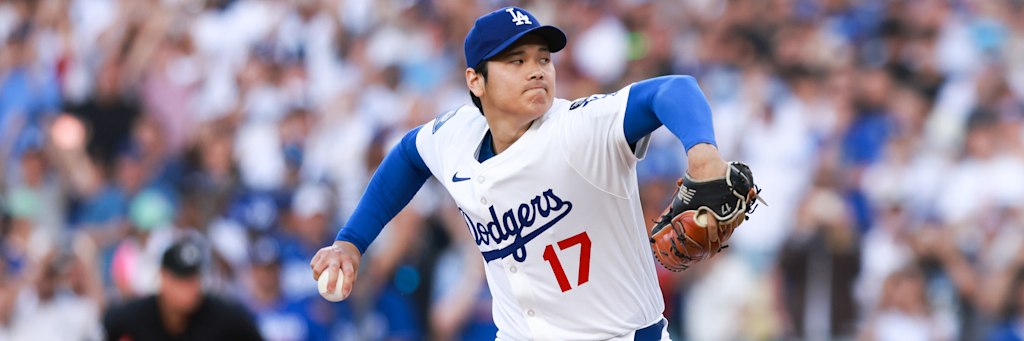
Low-scoring baseball is a function of starting pitching first and everything else second. The model that drives this board begins with a single question for every game: how many baserunners will the two starters allow, because a run cannot score without a runner reaching. On the July 10 slate, one game pairs the two lowest earned run averages of any matchup, and one game pairs the widest single-start ERA gap. Those two facts produce the two outputs below, ranked by how far the projection sits from the market number.
The Framework: Combined ERA And WHIP As Inputs
The model converts each starter's WHIP into an expected baserunner count over a projected workload, applies a league-average conversion rate to translate baserunners into runs, and folds in a park adjustment before comparing the output to the posted total or price. ERA is the sanity check that sits on top of WHIP, more volatile over one start but useful as a measure of established quality. When both starters in a game own sub-2.30 ERAs, the model's run distribution shifts down hard, and the total becomes the cleanest expression of the edge. When the two starters are separated by more than two runs of ERA, the moneyline becomes the expression instead.
Output 1: Diamondbacks-Dodgers Under 8.5 (-110)
This is the anchor of the board because it stacks two elite run-prevention starts on top of each other. Shohei Ohtani takes the Dodger Stadium mound at a 1.79 ERA, and Arizona counters with Eduardo Rodriguez at a 2.25 ERA. Their combined 4.04 ERA is the lowest paired figure on the entire July 10 slate, and the model treats a game with two sub-2.30 starters as a structurally low run environment before any lineup data is applied. Projected across the innings these two are likely to cover, the expected run total lands below the posted 8.5, and the -110 price only asks the under to clear a 52.4 percent break-even.
| Pitcher | ERA | Record | Team |
|---|---|---|---|
| Shohei Ohtani | 1.79 | 8-2 | Dodgers |
| Eduardo Rodriguez | 2.25 | 7-3 | Diamondbacks |
| Nick Martinez | 2.60 | 7-2 | Rays |
| Luis Castillo | 4.79 | 3-7 | Mariners |
The market has already respected the pitching in the moneyline, pricing the Dodgers at -255 as heavy home favorites, which tells you the books know how good these arms are. The under is where that same information is not fully priced, because the total still sits at a run-scoring baseline of 8.5 that a two-ace matchup should push beneath. The one caution the model flags is that both of these starters are efficient enough to hand games to bullpens by the seventh inning, and relief innings are where under bets go to die. That is why this is a measured lean on the total rather than a maximum-conviction play, but it remains the best-projected output on the slate.

Output 2: Tampa Bay Rays Moneyline (-116)
The second output is a starter-versus-starter projection, and the separation is large enough to move the number. Nick Martinez brings a 2.60 ERA and a 1.16 WHIP into Tampa Bay's home start opposite Luis Castillo, whose 4.79 ERA and 1.33 WHIP represent a 2.19-run ERA differential, one of the widest single-game gaps on the board. The WHIP spread is the more telling input for a win-probability model, because Martinez's 1.16 mark projects meaningfully fewer baserunners allowed than Castillo's 1.33, and fewer baserunners against the Rays lineup translates directly into a higher hold probability.
| Team | Record | Home or road split | Moneyline |
|---|---|---|---|
| Tampa Bay Rays | 54-37 | Home favorite | -116 |
| Seattle Mariners | 47-47 | Road underdog | -102 |
Context sharpens the projection. Tampa Bay owns the best record in the American League East at 54-37, a full ten games clear of a Seattle club sitting at exactly .500. A win-probability model built from the WHIP gap, the ERA differential, and the standings separation lands the Rays comfortably above the 53.7 percent break-even that a -116 favorite requires. The market has priced this near a coin flip, treating Seattle's road competence as heavier than the pitching data supports. Historically, a starter carrying a two-run ERA edge at home wins at a rate that near pick-em pricing does not capture, and that mispricing is precisely the kind of gap the model is designed to surface. The model disagrees with the number, and the distance between its projection and the -116 price is what makes this the second-ranked output on a board where run prevention is doing the heavy lifting.
What Breaks The Projections
Each output has a defined failure mode. The Diamondbacks-Dodgers under leans on both aces working deep, so an early exit from either Ohtani or Rodriguez that opens the middle innings to a bullpen, or a single crooked frame in a hitter's count, is the path over 8.5. Elite starters also occasionally trade zeros into the eighth and then surrender a late two-run rally that clears the number by itself. The Rays moneyline is the thinner projection by design: Martinez is efficient rather than dominant, Castillo has pitched better in his recent stretch than his season line, and a near pick-em favorite loses on any single swing that flips a one-run game. A model edge is a distribution across many simulations, never a guaranteed result on one night.
Model Verdict
The July 10 run-prevention model ranks the Diamondbacks-Dodgers under 8.5 at -110 first, driven by a 4.04 combined starter ERA that is the lowest on the slate, and it ranks the Tampa Bay Rays moneyline at -116 second, driven by a 2.19-run ERA gap over Luis Castillo and a ten game standings edge. For the method applied across earlier slates, work through the advanced stats hub, the daily MLB breakdown picks, the model home board, and the full model archive.