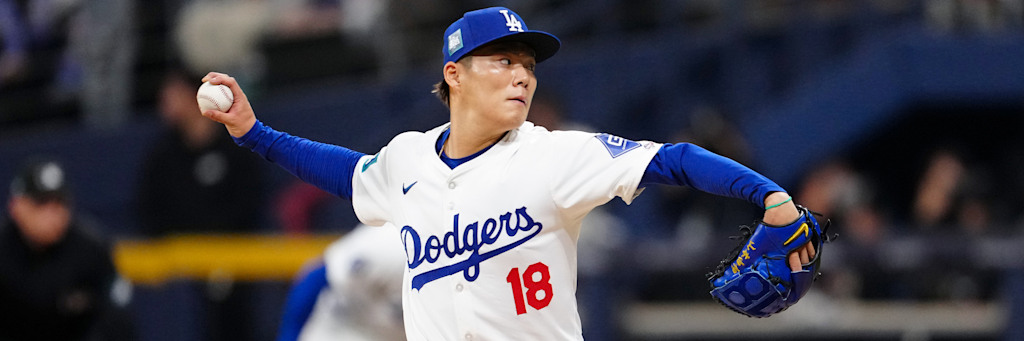
The model does not start with team logos. It starts with the rate stats that govern how many baserunners a starting pitcher allows, because walks plus hits per inning is the single cleanest predictor of run prevention we track, and on this Saturday slate two games sit at the extreme low end of the run-environment distribution. The Los Angeles Dodgers behind Yoshinobu Yamamoto project as one of the cleanest moneyline laydowns of the month, and the Texas Rangers at Boston Red Sox under 7.5 is a two-ace total compression with Jacob deGrom and Ranger Suarez carrying identical 3.18 ERAs into Fenway Park. Both are the same underlying read expressed in two betting markets: arms that suppress baserunners suppress runs.
Begin with the input that drives everything downstream. WHIP, walks and hits per inning pitched, is the variable our run-distribution model weights most heavily before park and lineup adjustments, because a starter who keeps the bases empty caps the upper tail of an offense's scoring distribution far more reliably than strikeout rate alone. When two of the four arms in these games sit below 1.00 WHIP and the other two sit near league average, the projected run totals collapse toward the under and the favorite, and the prices on both boards have not fully caught up.
The Dodgers Moneyline Is A WHIP Bet First, A Record Bet Second
Yoshinobu Yamamoto takes the ball at Rate Field carrying a 2.68 ERA, a 0.92 WHIP and 73 strikeouts across 77.1 innings. The 0.92 WHIP is the number the model cares about most: it means Yamamoto faces roughly the minimum number of hitters per inning, which strips scoring opportunities from a White Sox lineup that needs traffic to manufacture runs. Layer in a 44-26 Dodgers club that owns the best record in baseball and the deepest lineup in the sport, and the moneyline at -210 is not a record bet dressed as a pitching bet. It is a run-prevention projection with an offense attached.
Chicago counters with Sean Burke at a 3.88 ERA and a 1.18 WHIP. That is a competent profile, but it is a full run of ERA and a quarter-walk-and-hit per inning worse than Yamamoto, and the model reads that gap as roughly a run and a half of expected separation before the Dodgers lineup is even weighted in. At -210 the implied probability is about 68 percent, and the projection clears it: when the better arm by this margin fronts the better offense by this margin, the favorite price is the value the market is still discounting.
Verified Game Setups
| Matchup | Probable starters | Records |
|---|---|---|
| Dodgers at White Sox (Rate Field) | Yoshinobu Yamamoto (2.68 ERA, 0.92 WHIP) vs Sean Burke (3.88 ERA, 1.18 WHIP) | Dodgers 44-26 / White Sox 37-31 |
| Rangers at Red Sox (Fenway Park) | Jacob deGrom (3.18 ERA, 0.99 WHIP) vs Ranger Suarez (3.18 ERA, 1.14 WHIP) | Rangers 34-35 / Red Sox 28-39 |
Two games, four arms, and a combined run projection that sits below where both markets opened. The model's job is to find the spots where the published total or price lags the rate stats, and these two qualify.
Two 3.18-ERA Arms Compress The Rangers Red Sox Total
The under at Fenway is the purer expression of the thesis. Jacob deGrom fronts Texas with a 3.18 ERA and a 0.99 WHIP, sub-one baserunner traffic from one of the most efficient strike-throwers in the game. Ranger Suarez answers for Boston with a matching 3.18 ERA and a 1.14 WHIP. When both projected starters live in the same low-run band, the model's combined-total distribution shifts left, and a posted line of 7.5 sits above the projected mean rather than on it. That gap is the bet.
Fenway carries a deserved reputation as a hitter's park, and the model does not ignore it. The park factor nudges the projection back up, which is precisely why this is an under 7.5 play at -102 for 1.5 units rather than a heavier-staked under at a lower number. The deGrom and Suarez WHIP profiles do enough work to clear the park adjustment, but the cushion is thin, so the sizing stays measured. A 28-39 Red Sox offense facing a 0.99-WHIP arm and a 34-35 Rangers club facing a 1.14-WHIP lefty is the kind of double-cold-offense, double-quality-arm spot that compresses totals.
Why The Dodgers Carry More Weight Than The Under
The unit sizing tracks the confidence the model assigns each projection. The Dodgers carry 2 units because the Yamamoto-over-Burke gap is wide and the price, while steep, sits inside the projected win probability with room to spare. The Rangers Red Sox under carries 1.5 units because the edge is real but the Fenway park factor narrows the cushion, and the model never sizes a total at a hitter's park the way it sizes a clean favorite. Discipline in totals is what keeps a tracked under record from bleeding out on variance.
The broader board reads the same. The slate's other run-prevention anchor is the Tigers First 5 behind Tarik Skubal's 0.95 WHIP against a 1.51-WHIP opponent, another spot where the baserunner gap drives the projection. When the model lines up multiple plays on the same principle, it is not coincidence, it is the day's pitching distribution telling you offense is the underdog.
The Honest Counterpoint
Run-prevention projections are not immune to variance, and the case against both plays is worth stating plainly. The Dodgers at -210 give back the entire stake on one bad Yamamoto inning or an early bullpen handoff in a 3-2 game, and laying better than two-to-one means a single flat result hurts disproportionately. The under is exposed to exactly the thing the park factor warns about: Fenway can turn a routine fly into a three-run swing, and if either deGrom or Suarez gives back a crooked number early, a 7.5 total clears in a hurry. Two quality arms do not guarantee a quiet night.
That is why the model leans on the rate stats rather than the records. A 0.92 WHIP and two 3.18 ERAs are stable, repeatable inputs, and the projections built on them survive the occasional bad inning across a sample. You accept the variance on any single night because the underlying numbers are the ones that hold up over a season.
How The Numbers Set The Stakes
At -210 the Dodgers need to win about 68 percent of the time, and a Yamamoto start fronting the best team in baseball against a 3.88-ERA opponent clears that threshold in the model's simulations. At -102 the under needs roughly 51 percent, close to a coin flip, and a two-3.18-ERA matchup with both starters under a 1.15 WHIP projects above that even after the Fenway adjustment. The stakes scale with how far each projection sits from the market's implied number, nothing more.
What Beats It
An early Yamamoto exit beats the Dodgers ticket, where -210 leaves no margin for a tight game. The under dies to the Fenway park factor doing exactly what it does: one three-run inning from either side and a 7.5 total is suddenly live to the over. Both plays lean on the lower-WHIP arms holding their projected baserunner suppression deep into the game, which is what the rate stats forecast but never promise on a single night.
Final Verdict
The model's two run-prevention plays for this Saturday are the Los Angeles Dodgers moneyline at -210 for 2 units behind Yoshinobu Yamamoto's 0.92 WHIP at Rate Field, and the Texas Rangers at Boston Red Sox under 7.5 at -102 for 1.5 units behind two 3.18-ERA arms in Jacob deGrom and Ranger Suarez at Fenway Park. The edge is the same in both markets: starters who suppress baserunners suppress runs, and the published prices and total lag the rate stats. For more model reads, see our White Sox team total under projection, our Royals Rangers total breakdown, and the full prediction archive for how these run-prevention spots have landed.