A moneyline price is a probability in disguise. Convert -210 and it implies the favorite wins roughly 67.7 percent of the time at break-even; convert -184 and the implied break-even sits near 64.8 percent. The entire job of a win-probability model is to ask whether the projected probability clears that implied line by enough to justify the stake. On Monday's board, the two cleanest answers are both home favorites, and the single input doing the most work in both projections is starting-pitcher WHIP differential, the gap in baserunners allowed per inning between the two arms.
WHIP differential earns its weight because baserunners are the raw material of run expectancy. A starter who allows fewer men on base starves the opposing lineup of the base-out states that produce runs, which compresses the run distribution and pushes win probability up far faster than a strikeout-only read would suggest. When one side owns a large WHIP edge and the offenses are roughly comparable, the projection separates cleanly. That is exactly the structure of both the Cubs and Phillies spots.
The Cubs Projection: A 0.84-Run WHIP Gap
Shota Imanaga starts for Chicago carrying a 1.06 WHIP across 81 innings, with 81 strikeouts and a 4.44 ERA. Colorado answers with Michael Lorenzen and a 1.90 WHIP across 65.2 innings at a 7.54 ERA. The differential is enormous: 0.84 baserunners per inning. Stretched across a six-inning projection, that is roughly five extra baserunners the Rockies starter is expected to allow relative to the Cubs starter, and run-expectancy tables turn extra baserunners into runs at an accelerating rate once the bases begin to clog.
The offenses are close enough that the arms decide it. Chicago scores 4.57 runs a game on a .239 average and a .722 OPS; Colorado also sits at 4.57 runs a game on a .253 average and a .731 OPS. With comparable bats, the model leans almost entirely on the WHIP gap and the venue, and the projected Cubs win probability lands above the 67.7 percent implied by -210. That is a thin margin over the price, which is why this rates as a confident 3-unit stake rather than a blowout-priced lock; the edge is real but the line has already absorbed most of it.
| Game | Line | Implied break-even | Model driver |
|---|---|---|---|
| Cubs ML vs Colorado | -210 | ~67.7% | WHIP gap 1.90 vs 1.06, comparable offenses |
| Phillies ML vs Miami | -184 | ~64.8% | WHIP gap 1.44 vs 0.85, Wheeler run suppression |
The Phillies Projection: Wheeler As The Dominant Variable
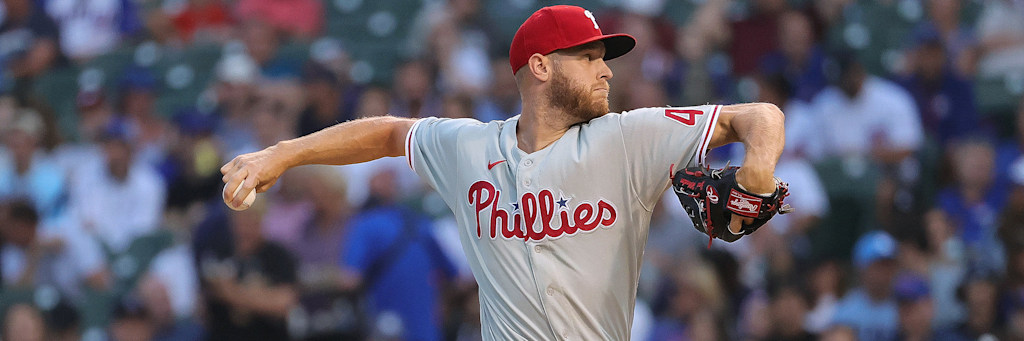
The Philadelphia projection is more lopsided at the top of the input list and more fragile at the bottom. Zack Wheeler carries a 0.85 WHIP across 56.2 innings, a 2.22 ERA, and 53 strikeouts; Ryan Gusto brings a 1.44 WHIP across only nine innings at a 6.00 ERA. The WHIP differential is 0.59, smaller than the Cubs gap in raw terms but more decisive in practice because Wheeler's 0.85 is elite, not merely good. Sub-0.90 WHIP means the model rarely projects the multi-baserunner innings that flip a tight game, so the variance around Philadelphia's win probability narrows even when its offense underperforms.
And the offense is the fragile input. Philadelphia scores just 4.01 runs a game on a .228 average, the lightest bat among the four teams in these two games. The model is explicitly projecting a low-scoring Phillies win, not a comfortable one, with Wheeler's run suppression carrying a thin offense across the line. Gusto's nine-inning sample adds projection uncertainty in both directions, but the model regresses a tiny sample toward the league mean rather than trusting the 6.00 ERA at face value, and even regressed, the gap to Wheeler clears the 64.8 percent break-even implied by -184.
| Matchup | Records | Offense inputs |
|---|---|---|
| Rockies at Cubs | COL 27-45 / CHC 37-35 | COL 4.57 R/G, .731 OPS / CHC 4.57 R/G, .722 OPS |
| Marlins at Phillies | MIA 36-36 / PHI 38-33 | MIA 4.31 R/G, .706 OPS / PHI 4.01 R/G, .681 OPS |
Why The Model Does Not Fade Either Favorite
A disciplined model looks for reasons to take the plus-money side, and here it does not find them. Colorado is a road team at 13-25 away with the slate's worst travel profile, throwing the highest WHIP starter on the board; the dog price prices in a competitiveness the inputs do not support. Miami has been the hotter team lately at 8-2 over ten games, which is the one input that gives the model pause, but recent form is a noisy signal that the WHIP differential and the 13-20 road record both outweigh in the projection. Hot streaks regress; a 0.85-WHIP ace does not.
Sizing is uniform at 3 units because, in both games, the projected win probability clears the implied break-even by a comparable margin. The Cubs edge comes from the larger raw WHIP gap; the Phillies edge comes from the higher quality of the favored arm. Different mechanisms, similar net edge, identical stake. The model is not chasing a number, it is reporting where projected probability and market price diverge.
The Honest Counterpoint
A win-probability model outputs a distribution, and both of these favorites lose a real share of the time they are correctly priced to win. The Cubs projection assumes Imanaga's 1.06 WHIP holds against a Rockies lineup posting 4.57 runs a game, and one crooked inning from a non-elite arm collapses the edge. The Phillies projection is the more brittle of the two: it leans on a 0.85-WHIP ace to carry a .228-hitting offense, so a short Wheeler start or a quiet Philadelphia bat against even a small Gusto sample sinks it. Gusto's nine innings are too few to trust, which cuts both ways. Calibration is judged over a season, not on one Monday.
What Beats The Projection
The Cubs moneyline loses if Lorenzen, against his 7.54-ERA baseline, posts a quiet five and the Cubs bats sit at their .239 average. The Phillies moneyline loses if Wheeler is hooked early or Philadelphia's bottom-three-on-the-slate offense fails to manufacture the two or three runs the projection needs. Short home favorites do not forgive a flat start, and the model expects to lose a meaningful fraction of these by design. Favored by the projection is not the same as safe.
Final Verdict
The June 15 model leads with two WHIP-differential plays: the Chicago Cubs moneyline at -210 for 3 units on a 0.84-baserunner edge for Imanaga over Lorenzen, and the Philadelphia Phillies moneyline at -184 for 3 units on Wheeler's 0.85 WHIP carrying a light offense. For more projection work from this stretch, see our June 14 run-expectancy under model, our June 12 run-expectancy projection card, and the full projection archive for how these inputs have calibrated.