A team total is a cleaner modeling problem than a game total, because it strips out half the noise. You are not projecting two offenses and two pitching staffs at once. You are projecting one lineup's expected run production against one starter and one bullpen, and that narrower question is where a projection model gets its sharpest read. On this Friday board, the cleanest answer the model returns is the Angels team total under 3.5 at -125 for 2 units, and the inputs are not subtle.
The Angels carry a .233 team batting average and a .701 OPS, the lowest offensive output of any club on tonight's main slate. That is not a one-week slump, it is a 69-game sample, which means the model treats it as a stable input rather than a regression candidate. Against an average starter you would still project this lineup near three and a half runs. Against the starter they are actually facing, the projection drops below it.
Why The Angels Under 3.5 Is The Model's Top Read
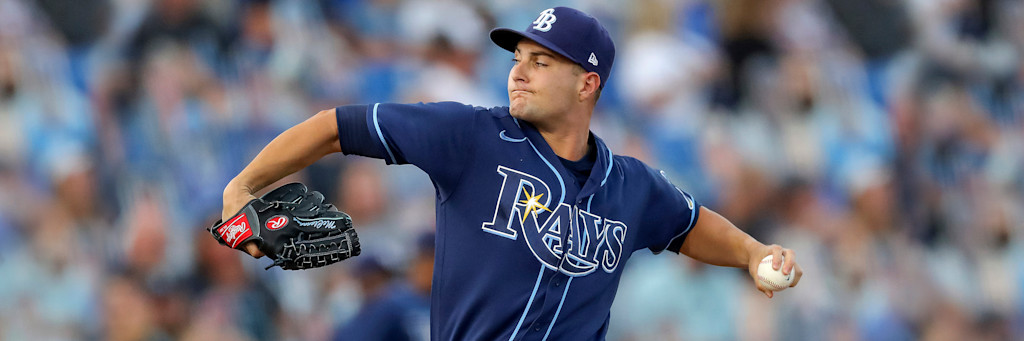
Shane McClanahan is the variable that pushes the distribution under the number. He is 6-3 with a 2.85 ERA and a 1.10 WHIP across 60 innings and 12 starts, and the headline beneath those numbers is his changeup, a put-away offering that generates chase and weak contact against a lineup that already runs a below-average on-base profile. When you feed a low-OPS offense into a per-plate-appearance run-value model and the opposing starter suppresses both the walk and the extra-base hit, the expected-runs curve compresses hard. The model's median outcome for the Angels lands under 3.5, and the -125 price implies roughly a 55.6 percent break-even, a bar the projection clears.
The Angels send Sam Aldegheri to the mound, but that arm is irrelevant to this particular bet. The team total is a question about the Angels' bats and Tampa Bay's run prevention, full stop, and both inputs point the same direction. That alignment, a weak lineup plus a suppressing arm with no offsetting park boost in Anaheim, is exactly the signal the model is built to flag.
The Mariners Moneyline And A 0.78 WHIP Input
The model's second-strongest read is the Seattle Mariners moneyline at -142 for 3 units at Washington, and it is a starter-driven projection. Bryce Miller has thrown 27 innings over his last four starts with a 1.33 ERA, a 0.78 WHIP, and 29 strikeouts. A sub-0.80 WHIP is an extreme input, and even after the model regresses it toward his true talent, the baserunner-suppression component dominates the win-probability calculation. Washington's 4.66 team ERA and a Zack Littell start carrying a 4.76 ERA and a 1.31 WHIP sit on the other side of the ledger. The projected win probability for Seattle clears the -142 break-even of roughly 58.7 percent, which is why this rates as the heaviest stake on the card despite the near-even records of 36-34 and 35-34.
Nationals Under 3.5 As The Correlated Plus-Money Lane
The same game produces a third entry, the Nationals team total under 3.5 at +113 for 1.5 units. This is the run-suppression side of the Miller projection expressed as a plus-money number. The model projects Washington's expected runs below four against Miller's current contact-suppression profile, and at +113 the implied break-even is only about 46.9 percent, well under the model's hit rate on the under. Plus money on a quiet projected total is a structurally efficient bet, and it correlates cleanly with the Mariners side without being redundant, because a 3-2 Seattle win cashes the moneyline while the under needs Washington capped specifically.
| Play | Line | Implied break-even | Model lean |
|---|---|---|---|
| Angels team total under 3.5 | -125 | ~55.6% | Under, .701-OPS bats vs McClanahan |
| Mariners ML at Washington | -142 | ~58.7% | Seattle, 0.78 WHIP starter input |
| Nationals team total under 3.5 | +113 | ~46.9% | Under, plus-money run suppression |
| Giants ML vs Cubs | -114 | ~53.3% | San Francisco, Oracle park factor |
Giants Moneyline And The Oracle Park Factor
The lightest model lean is the San Francisco Giants moneyline at -114 for 1.5 units against the Cubs, and it is the one bet on the card driven less by a starter's stat line than by an environment. Oracle Park is one of the most run-suppressing venues in the league, with a deep right-center gap and a marine layer that shortens fly-ball distance, and that park factor compresses the run distribution in a way that helps the home side in a tight matchup. Landen Roupp brings a legitimate strikeout profile, 77 punchouts across 69.2 innings and 13 starts at a 4.00 ERA, while Javier Assad has thrown just 32.1 innings in three 2026 starts, a thin sample the model treats with wide error bars. San Francisco's 28-41 record is the honest drag on the projection, which is why the implied edge is small and the stake stays at 1.5 units rather than anything heavier.
Verified Model Inputs
| Game | Records | Starter inputs |
|---|---|---|
| Rays at Angels | TB 40-25 / LAA 27-42 | McClanahan 2.85 ERA, 1.10 WHIP / Aldegheri 2.25 ERA |
| Mariners at Nationals | SEA 36-34 / WSH 35-34 | Miller 1.33 ERA, 0.78 WHIP / Littell 4.76 ERA, 1.31 WHIP |
| Cubs at Giants | CHC 35-34 / SF 28-41 | Assad 4.73 ERA / Roupp 4.00 ERA, 77 K |
The Honest Counterpoint
A projection model outputs a distribution, not a guarantee, and the tail risk on every one of these is real. The Angels under can be broken by a single three-run inning, because team totals are right-skewed and one swing carries the number even when the median projection is comfortably below it. The Mariners moneyline asks the model to be correct about a road favorite in a near-even record matchup, and a strong Littell start collapses that edge inside one game of variance. The Nationals under at plus money exists precisely because the offense is live enough to clear four on a given night. The Giants lean leans hardest on a park factor and a thin Assad sample, the two least certain inputs on the board. Calibration over a season is the goal, and no single night validates or refutes a model that is only ever playing probabilities.
How The Model Sizes The Card
Stake follows the gap between projected probability and implied break-even. The Mariners moneyline shows the widest gap, so it carries 3 units. The Angels under pairs a stable low-OPS input with a suppressing arm, earning 2 units. The Nationals under takes 1.5 units on a plus-money number where the break-even sits well below the model's hit rate. The Giants moneyline takes 1.5 units as the park-driven lean where record quality caps the edge. The sizing is the model talking, not a feeling, and it reads as a measured card rather than a high-variance swing.
What Beats It
A single crooked inning beats either under, since team-total distributions are dominated by the rare multi-run frame. A clean Littell outing and a quiet Seattle bat flips the Mariners projection inside the variance band. A Cubs lineup that travels and a flat Roupp start sinks the Giants park lean. The model is favored on each, but favored is not certain, and a calibrated projection expects to lose a meaningful share of bets it is correctly priced to win.
Final Verdict
The model card leads with the Angels team total under 3.5 at -125 for 2 units against McClanahan and a .701 OPS, anchors with the Mariners moneyline at -142 for 3 units behind a 0.78 WHIP, adds the Nationals team total under 3.5 at +113 for 1.5 units as the plus-money lane, and closes with the Giants moneyline at -114 for 1.5 units on the Oracle Park factor. For more model work from this board, see our read on the Braves win-probability projection at the White Sox, our breakdown of the Red Sox Rays under projection, and the full projection archive for how these inputs have calibrated.