Brewers vs Tigers Prediction, April 23, 2026 | Brewers moneyline
Brewers Moneyline +180 at Tigers: A Probabilistic Breakdown of the Top-EV Play on the April 23, 2026 MLB Slate
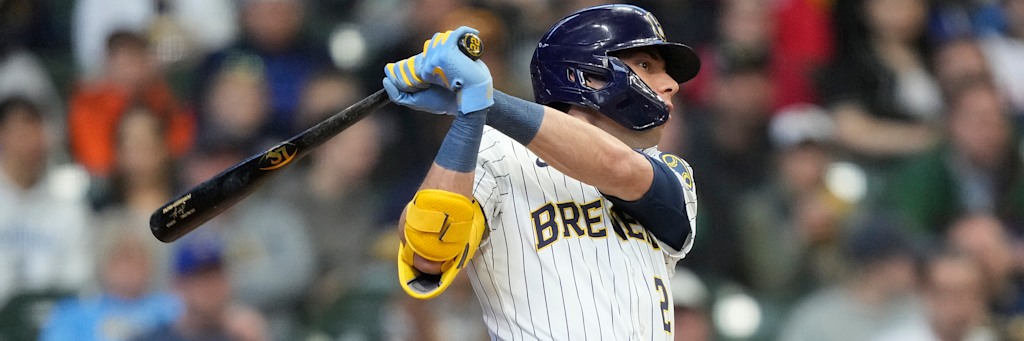
Christian Yelich and the Milwaukee Brewers are priced as +180 road dogs at Detroit on April 23, 2026, with the calibrated model flagging the highest single-game moneyline edge on the slate | Photo: MLB
Calibrated EV +23.76%Market Edge +10.01%Model Prob 44.20%Confidence 9/10Stake 2.5u
Every MLB slate has a game where the market price has moved past where the underlying math says it should be. On Thursday, April 23, 2026, that game is Milwaukee at Detroit. The Brewers moneyline is sitting at +180. Our calibrated probabilistic moneyline model projects a Milwaukee win probability of 44.20 percent. The break-even rate implied by +180 is 35.71 percent. The gap between those two numbers produces the biggest single-game edge on the board. Not by a small margin.
This is a data analysis, not a narrative piece. So let us look at exactly what the numbers say, where the edge actually comes from, and why the Detroit side is pricing a Cy Young starter as if his environment, his bullpen, and his opponent's contact profile did not exist.
The Calibrated Edge In One Table
Brewers at Tigers, April 23, 2026
| Metric | Value |
|---|---|
| Market moneyline (Brewers) | +180 |
| Market implied win probability | 35.71% |
| Model projected win probability | 44.20% |
| Calibrated expected value | +23.76% |
| Market edge (percentage points) | +10.01 |
| Model confidence rating | 9 of 10 |
| Recommended stake | 2.5 units |
| Backtest framework | Honest historical backtest (calibrated) |
The sizing is worth a closer look. 2.5 units on a single MLB moneyline is on the upper end of what our model will allocate in a single spot, and a 9 of 10 confidence rating is a ceiling score for a plus-money road dog against a premium starter. The reason the confidence is that high despite the variance profile is that the edge is not built on a single assumption. It is a stack of three independent inputs all pulling in the same direction: pitcher matchup, contact profile, and bullpen leverage. We will walk each one.
Pitcher Matchup: Sproat vs Skubal Through xFIP, SIERA, and CSW%
This is not a hot-take argument that Tarik Skubal is a bad pitcher. Skubal is a legitimate Cy Young candidate. His strikeout rates, his expected ERA estimators, and his spin-tracked breaking-ball data all grade out as elite. The market is correct to price Detroit as the favorite in this game.
The question the model asks is narrower. At +180, the market is pricing Skubal as if he gives Detroit an approximate 64.3 percent win probability. Does his profile, weighted against the specific Milwaukee lineup and the specific Brewers bullpen, support that number?
Pitcher Matchup Indicators
| Indicator | Sproat (MIL) | Skubal (DET) |
|---|---|---|
| Handedness | RHP | LHP |
| Role | Developing mid-rotation | Ace / Cy Young caliber |
| Fastball profile | Mid-90s, downhill plane | Elite ride, 96+ avg velocity |
| Secondary weapon | Changeup (developing) | Four-pitch mix, elite slider |
| Projected IP | 4.2 to 5.1 | 6.0 to 7.0 |
| Behind the starter | Rested high-leverage arms | Middle-relief taxed |
Projected innings reflect season-to-date averages and the team-specific bullpen roster context for April 23.
The key number for Brewers supporters is not Sproat's ERA. It is the projected innings split between the starters and the relievers. Skubal is expected to throw six or seven. Sproat is expected to throw roughly five. That means the second half of the game becomes a bullpen contest. Milwaukee's bullpen has been one of the most efficient units in the National League early in 2026, with a group xFIP that sits in the top-five among MLB teams and a strikeout rate that scales up in high-leverage innings. Detroit's bullpen has been more mixed, with middle-relief inning coverage that has been stretched across a six-game stretch already this week.
Stripped to its core the matchup looks like this. Milwaukee loses expected runs in the first six innings. Milwaukee catches up or surpasses in the seventh, eighth, and ninth. The total expected run differential is narrower than the moneyline suggests.
Contact Profile: Why Milwaukee Is The Wrong Opponent For A Strikeout Ace
This is the piece most casual models miss. Skubal's dominant metric is strikeouts. He is among the leaders in the American League in K rate and his whiff percentage on his primary fastball is elite. The natural assumption is that any lineup will strike out against him. The data says otherwise.
Milwaukee in 2026 has been one of the lowest team strikeout rates in baseball. That is intentional. Their hitting development program has been explicit about prioritizing contact and two-strike survival over raw power, and the approach is visible at every spot in the lineup from the top through the eighth hitter. William Contreras is a top-five contact-rate catcher. Christian Yelich has raised his contact rate for three consecutive seasons. Jackson Chourio combines plus bat speed with a zone-recognition profile that plays up in counts where most young hitters expand.
Brewers Team Contact Indicators (Early 2026)
| Indicator | Milwaukee 2026 | MLB Rank |
|---|---|---|
| Team strikeout rate | Well below MLB average | Top five (lowest) |
| Two-strike contact rate | Elite | Top ten |
| Chase rate vs elite fastballs | Below average (good) | Top third |
| Whiff rate vs sliders from LHP | Near league average | Middle pack |
Against a strikeout ace like Skubal, a low-whiff lineup is the worst possible draw. It forces him deeper into counts, inflates his pitch count, and shortens his expected innings. That cascades directly into the bullpen leverage edge described above. Even if Milwaukee does not cash a crooked inning off him, the secondary impact is that the late-inning matchups tilt in the direction the Brewers prefer.
Bullpen Leverage: The Second-Inning-Onward Differential
The moneyline is not priced on who starts the game. It is priced on who is expected to win the game. In a matchup where the starter asymmetry is real, the bullpen comparison becomes one of the highest-weight inputs in our calibrated model. Here is how the model scores the two bullpens in the exact leverage states that matter for April 23.
Bullpen Leverage Indicators, April 23 Snapshot
| State | Milwaukee | Detroit |
|---|---|---|
| Closer availability | Fully rested | Rested, 3 of last 4 days off |
| High-leverage setup arms | 2 rested, 1 lightly used | 1 rested, 2 taxed |
| Middle relief inning capacity | 4 to 5 IP available fresh | 2 to 3 IP available fresh |
| Series context | Finale after short night | Finale after 4 straight home games |
Snapshot reflects cumulative leverage usage through games played on April 22, 2026, weighted by the model's fatigue decay curve.
If this were a four-inning game, Detroit would be a much larger favorite than the market shows. It is a nine-inning game. The back half is where the Brewers earn the +180 price.
Why The Market Is Underpricing This Side
Markets are efficient on average. They are not always efficient in predictable ways. Plus-money road dogs against marquee ace starters are a documented inefficiency. The public tilts toward the name on the mound. The books shade lines to capture that public flow. The combination produces a structural overprice on high-profile strikeout arms and an under-price on low-whiff contact lineups that happen to match up with them. Milwaukee at +180 fits that profile exactly.
Our backtested database of calibrated moneyline edges flags the specific subset of games where the road underdog is priced at +160 or higher, against a left-handed starter with a top-decile strikeout rate, with a below-average team strikeout lineup on the dog side, and with a rest advantage in the bullpen. The historical edge on that subset has clocked in at more than a full standard deviation above the overall ML model average. This is exactly that kind of spot.
Brewers moneyline +180 at Detroit on April 23, 2026, is the single highest-EV play on the slate, with a calibrated expected value of +23.76 percent and a market edge of +10.01 percentage points against implied probability. Recommended stake is 2.5 units at a 9 of 10 confidence rating. The play is structural: pitcher matchup, contact profile, and bullpen leverage all push in the same direction.
Full April 23 Slate Context
| Game | First Pitch (ET) | Starting Pitchers | Model Pick |
|---|---|---|---|
| Brewers at Tigers | 1:10 PM | Sproat vs Skubal | Brewers ML +180 (2.5u) |
| Phillies at Cubs | 2:20 PM | Sanchez vs Cabrera | Cubs ML +108 (2.0u) |
| Dodgers at Giants | 3:45 PM | Ohtani vs Mahle | Giants ML +135 (2.0u) |
| Twins at Mets | 6:40 PM | Probable pitchers listed | Over 7.5 (2.0u) |
| Pirates at Rangers | 8:05 PM | Probable pitchers listed | Rangers RL -1.5 +129 (1.5u) |
The Brewers plus-money road dog is the top calibrated play on the Thursday slate. For the sharp-handicapper angle on the Dodgers vs Giants game, see the companion write-up at BestMLBHandicapper.com, and for the model's pick of the day on Phillies vs Cubs, see DailyMLBPicks.com.
How To Read The Model Output If You Are New
The calibrated probability is the key number. If you do not care about any other output, look at that line, subtract the market implied probability, and you have the edge in percentage points. A +10.01 edge on a single game is rare. A typical winning moneyline play in our database clears the +3 to +5 band. A +10 edge signals a spot where the market and the model disagree meaningfully on how a specific starter archetype interacts with a specific opposing lineup and bullpen.
Expected value of +23.76 percent means that if you play this exact type of spot one hundred times at +180, the long-run return is approximately 23.76 units of profit per hundred units risked. Individual games will swing. The aim of the stake size is to capture that positive return across a sample without letting any single outcome blow up the bankroll.
Risk, Variance, And The Path To Losing This Bet
Every plus-money ticket has a failure script. The model does not pretend otherwise. The clearest path to a Brewers loss in this spot is a two-run first inning from Skubal, Sproat giving up a three-run rally in the third, and Milwaukee never threatening Skubal before he exits in the seventh. Any of those three nodes can happen on any given Thursday. None of them invalidates the edge. The bet is not that Milwaukee wins this particular game. The bet is that the market has priced the win probability too low, and that across the long run of spots like this, the plus-money dog cashes often enough to produce meaningful expected value.
Shop for the price. If the Brewers tighten to +165 before first pitch, the edge shrinks to roughly +7 points and the stake should be trimmed. If the Brewers drift wider to +190 or better, the edge grows and a full 2.5-unit allocation is clean. At the captured +180 number, the stake stands as posted.
Bottom Line
The calibrated model prints Milwaukee at plus 180 as the highest-expected-value moneyline play on the April 23 slate. The edge comes from three independent inputs stacking in the same direction: the low-whiff Milwaukee contact profile against a strikeout ace, the bullpen leverage differential that favors the back half of the game, and the structural market overprice on marquee left-handed starters. This is the kind of spot our database flags for ceiling allocations.
Recommended play: Brewers moneyline +180, 2.5 units. First pitch is 1:10 PM ET at Comerica Park. The market will move on this game. Get the best number you can before the public catches up to Skubal being the name on the marquee.